
Waw — 𐤅
Sixth letter of the Phoenician alphabet.
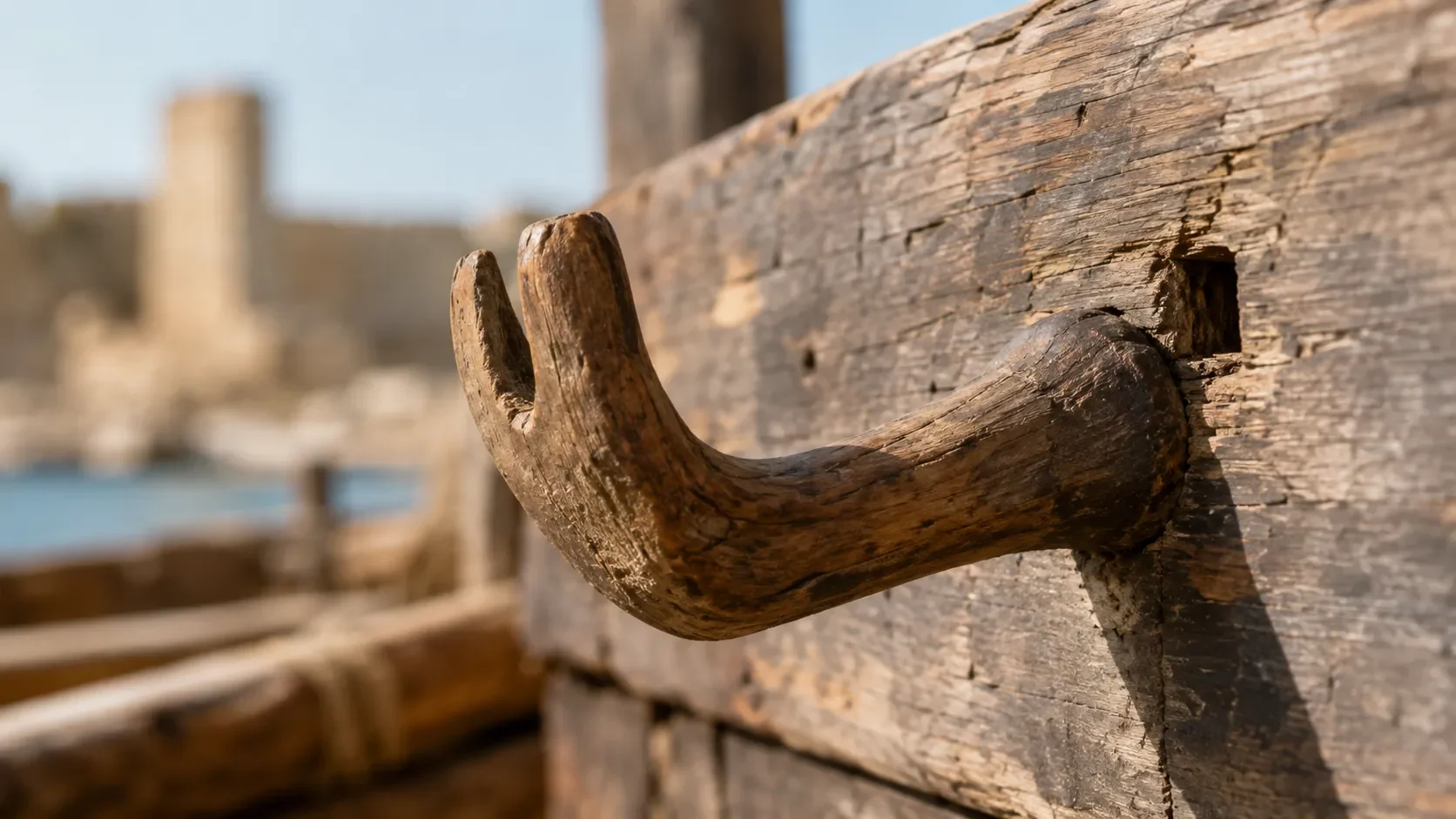
Before F, U, V, W and Y, there was Waw.
𐤅 is the sixth of the twenty-two letters of the Phoenician alphabet. It represents the consonantal sound /w/.
Its name, Waw, is traditionally associated with a hook or peg. Its earlier pictographic history is less certain: possible prototypes proposed for the Proto-Sinaitic sign include forms resembling a mace, an oar or a crook, which may have been understood by Semitic speakers as types of hooks.
The exact pictographic origin therefore remains debated.
With Waw, however, the most remarkable part of the story comes later.
One Phoenician letter would ultimately contribute to the history of several characters in the alphabets we use today.
From an early sign to a consonant
In the earliest Semitic alphabets, signs gradually evolved from recognisable images into increasingly abstract forms.
For Waw, the name preserved in the Semitic alphabetic tradition is associated with the idea of a hook or peg.
Over time, the sign develops into the Phoenician form:
𐤅
In the Phoenician alphabet, Waw occupies the sixth position and represents the consonant /w/.
This sound value would play an important role when the letter was adapted into Greek.
From Waw to several letters
When the Greeks adapted the Phoenician alphabet, Waw followed an unusual path.
One adaptation preserved its consonantal value /w/ and became:
Digamma — Ϝ
Digamma originally occupied the sixth position in early Greek alphabets. Its use as a sound eventually disappeared from many Greek dialects, but the letter continued its journey elsewhere.
Through western Greek and Italic writing traditions, Digamma contributed to the development of the Latin:
F
But Waw also followed another Greek branch.
The Phoenician sign was adapted as:
Upsilon — Υ
From this branch emerged forms that eventually contributed to the Latin V, from which U and W were later differentiated.
The Latin Y was also introduced later from Greek Upsilon.
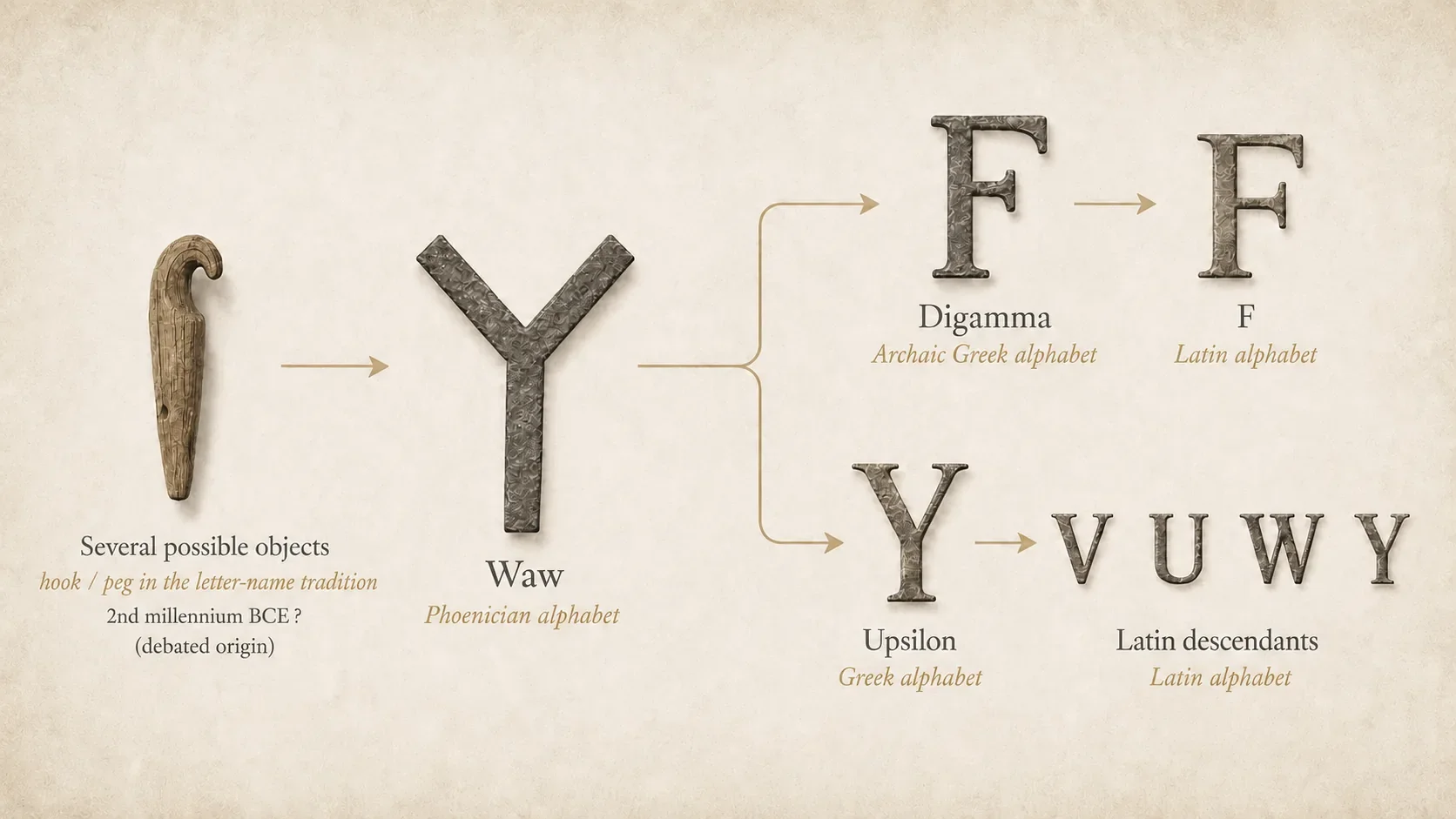
The history of Waw therefore does not follow a single line:
𐤅 → Ϝ → F
and
𐤅 → Υ → V → U / W
with Y also descending from the Greek Upsilon tradition.
A single Phoenician letter thus lies, ultimately, behind several characters still used every day.
Waw and Byblos
In Byblos, Waw can be read in one of the city’s most important Phoenician inscriptions: the inscription on the sarcophagus of King Ahiram.
Several groups in the inscription begin with the letter corresponding to Waw — 𐤅.
In transliterations of the text, forms such as:
W’L — WSKN — WTM’
show the presence of Waw.
In these passages, the letter can also serve as the conjunction commonly translated as “and”.
Waw is therefore not simply an isolated character in the history of writing.
It forms part of the structure of an actual Phoenician text engraved at Byblos nearly three thousand years ago.
The Ahiram inscription belongs to the group of inscriptions that materially connect Byblos with the history and diffusion of the Phoenician alphabet.
Conclusion
Waw has an exceptional legacy.
The Phoenician letter 𐤅, used to represent /w/, was adapted in the Greek world as Digamma — Ϝ and also contributed to the history of Upsilon — Υ.
From these two branches would eventually emerge several Latin letters:
F, U, V, W and Y.
With Waw, the transmission of the alphabet becomes visibly complex: not a perfectly straight succession of signs, but a history of adaptations, branches and transformations.