
Zayin — 𐤆
Seventh letter of the Phoenician alphabet.
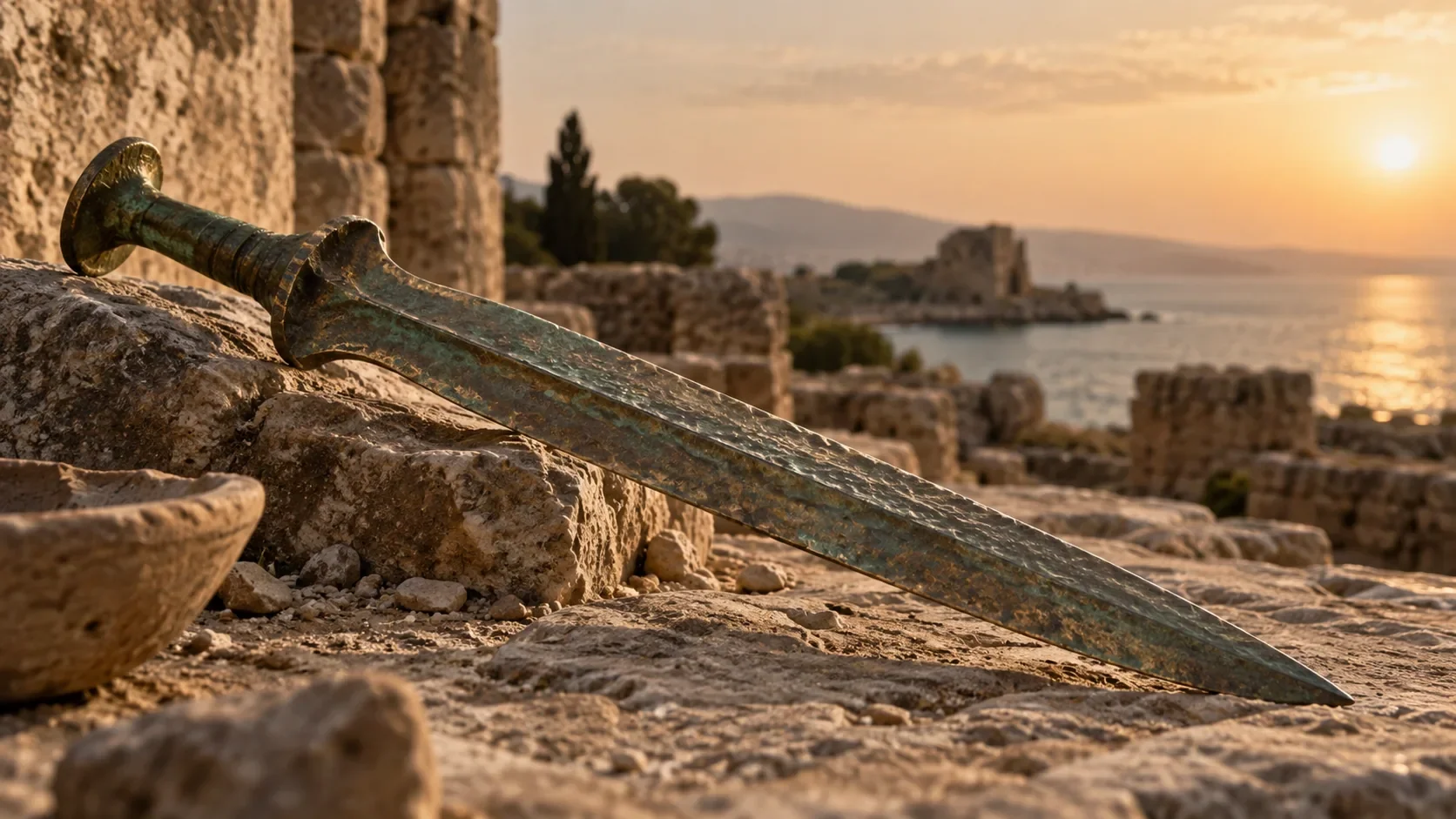
Before Z, there was Zayin.
Zayin is the seventh of the twenty-two letters of the Phoenician alphabet. In this consonantal writing system, it represents the sound /z/.
Its pictographic origin is more difficult to determine than that of letters such as Aleph or Beth. In Semitic traditions, the name Zayin has been associated with vocabulary relating to weapons or weaponry, but this connection does not allow us to identify with certainty the object represented by the earliest forms of the sign.
Several reconstructions have been proposed. They include different objects or shapes that may have been connected with tools or weapons, but no single identification can be considered definitively established.
With Zayin, the story becomes much clearer once the letter enters historically documented alphabets.
The letter Zayin (𐤆) would give rise to Greek Zeta — Ζ, and later become part of the history of the Latin Z.
What did Zayin represent?
In the earliest alphabetic writing systems, several signs still retain a connection with objects from the physical world.
For Zayin, however, the original object has not been identified with certainty.
The name preserved in the Semitic tradition is associated with the idea of a weapon. Several interpretations have been proposed for the early forms of the sign, but they do not allow us to reconstruct a single pictogram with certainty.
It would therefore be too categorical to present Zayin as the simple stylisation of a sword, dagger or any other specific weapon.
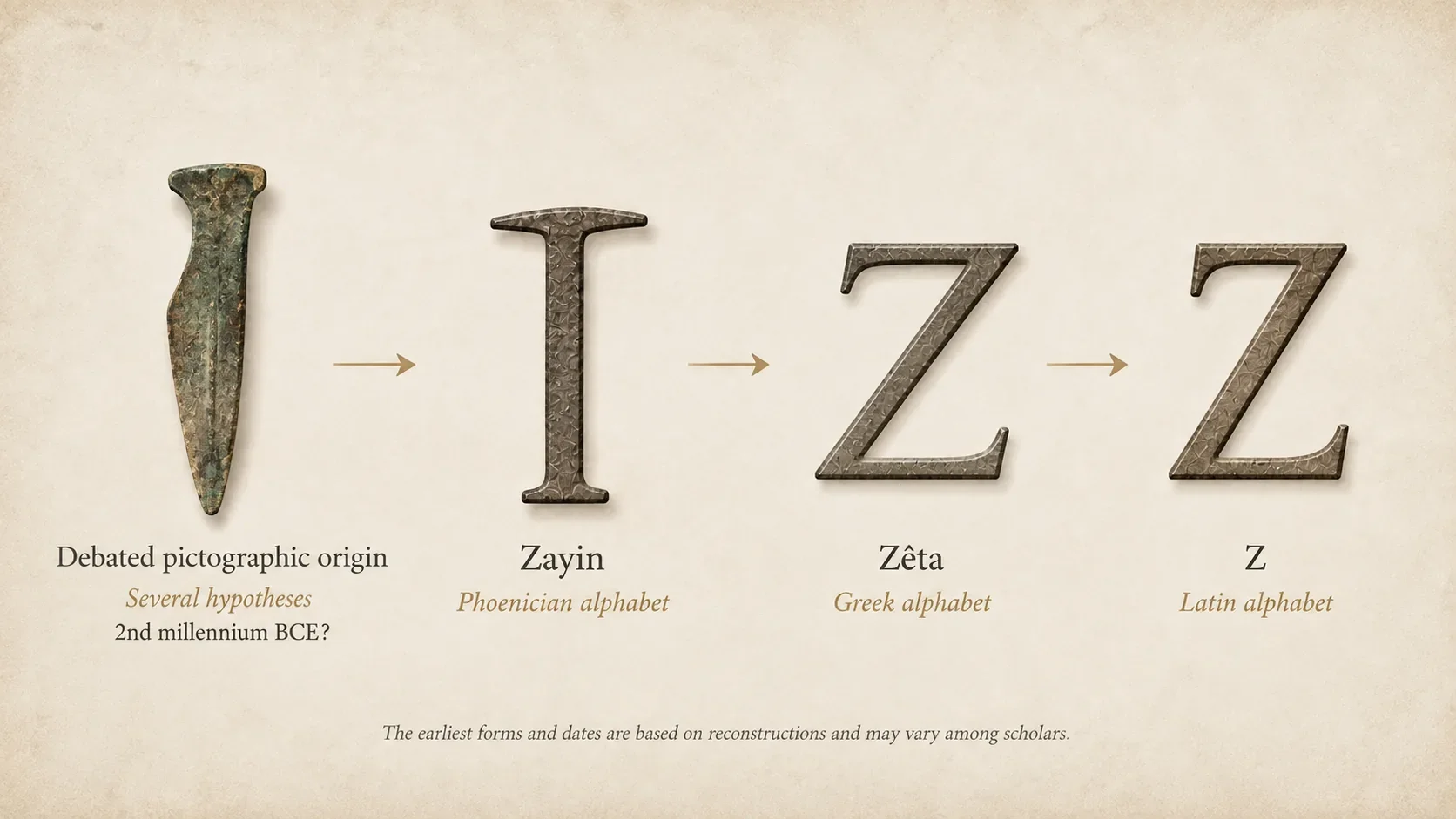
The pictographic origin of Zayin remains debated.
What is much better established is its function within the Phoenician alphabet: Zayin (𐤆) occupies the seventh position and represents the consonant /z/.
From this point onward, we leave the more uncertain field of pictographic reconstruction and follow a much better documented alphabetic transmission.
From Zayin to Zeta, then Z
When the Greeks adapted the Phoenician alphabet to their own language, Zayin was adopted as Zeta — Ζ.
The historical connection between Zayin and Zeta is well established, even though the phonetic value of Zeta during different periods of Ancient Greek is more complex than that of the modern /z/ sound.
The letter was then transmitted through the alphabets of ancient Italy and eventually into Latin.
The history of Latin Z, however, has a particular twist: the letter was present in early forms of the Latin alphabet, but later fell out of use when the corresponding sound disappeared from Old Latin.
The Romans subsequently reintroduced Z, together with Y, in order to represent words borrowed from Greek more accurately.
By then, its former place in the alphabet had already been occupied, so Z was placed at the end of the Latin alphabet.
Its transmission can therefore be summarised as:
Zayin — 𐤆 → Zeta — Ζ → Z
A letter that began in the seventh position of the Phoenician alphabet thus reached the final position of our alphabet after a history of transmission, abandonment and reintroduction.
Zayin and Byblos
In Byblos, Zayin is attested in ancient Phoenician royal inscriptions.
One example appears in the inscription of King Yehimilk, one of the archaic inscriptions of Byblos, generally dated to the beginning of the first millennium BCE.
The transliterated sequence ZBNY appears in the text.
Its first consonant corresponds to Zayin (𐤆).
In this inscription, the initial Z is analysed as a grammatical element introducing what Yehimilk, king of Byblos, states that he built or restored.
Zayin is therefore not simply a letter preserved in an alphabet chart.
In Byblos, it appears within a language actually carved into stone, in inscriptions used by the rulers of the city.
Conclusion
With Zayin, the history of a letter follows a distinctive path.
Its pictographic origin remains debated, but its function within the Phoenician alphabet is clear: Zayin (𐤆) represents the consonant /z/.
Transmitted to the Greek world, it became Zeta — Ζ, before entering the history of the Latin alphabet.
Zayin — 𐤆 → Zeta — Ζ → Z
Old Latin would eventually abandon the letter before reintroducing it several centuries later to write words borrowed from Greek.
A letter that began in the seventh position of the Phoenician alphabet thus stands today at the very end of our alphabet.