
Heth — 𐤇
Eighth letter of the Phoenician alphabet.

Before H, there was Heth.
Heth is the eighth of the twenty-two letters of the Phoenician alphabet. In this consonantal writing system, it represents a voiceless pharyngeal consonant, generally reconstructed as /ħ/ and transliterated ḥ.
Its pictographic origin is less certain.
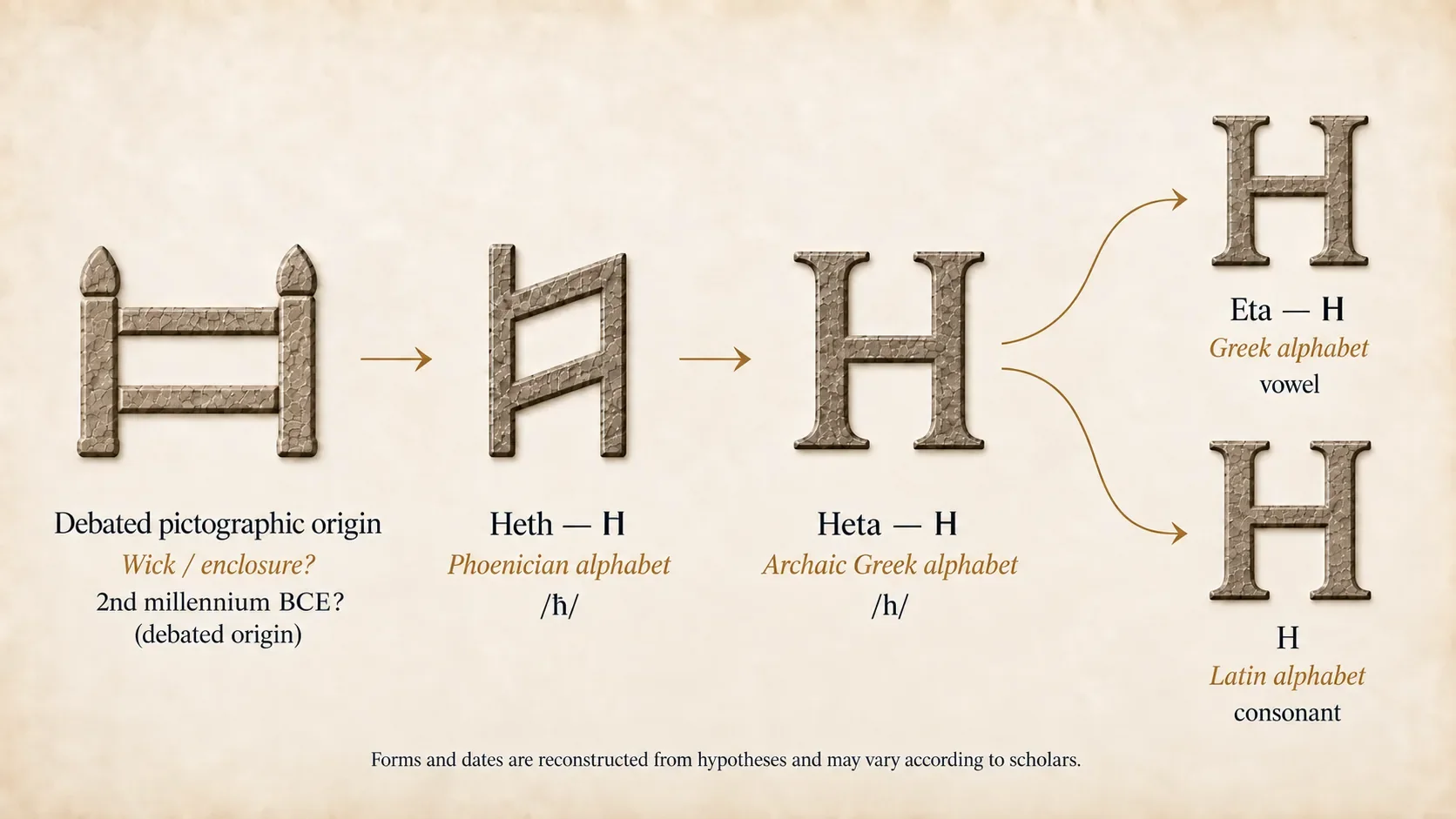
Some traditions have associated Heth with an enclosure, courtyard or barrier. Another important reconstruction of the Proto-Sinaitic signs instead identifies its ancestor with a lamp wick.
With Heth, it is therefore important to distinguish between what can be reconstructed from the earliest signs and what is much more securely established in the historical alphabet.
The letter Heth (𐤇) gave rise to an archaic Greek letter used for /h/, conventionally called Heta — Η, before following two different paths: in Greek it developed into Eta — Η, while its western branch contributed to the Latin H.
Several readings for the same sign
In the earliest alphabetic writing systems, the image behind a letter is not always easy to identify.
Heth is a good example.
One tradition connects its name and form with an enclosure or courtyard. This interpretation has long influenced charts that present the letter as deriving from some form of fence or barrier.
Research on the Proto-Sinaitic corpus, however, has also proposed another possibility.
In her study of the Sinai inscriptions, Egyptologist Orly Goldwasser discusses the identification of a Proto-Sinaitic sign as a lamp wick. A closely related Egyptian hieroglyph, with a comparable consonantal value, is also well attested in the region. The vertical orientation of the Proto-Sinaitic sign may even reflect a direct graphic relationship with that model.
It would therefore be too categorical to present Heth simply as the stylisation of a fence, an enclosure — or a wick.
The exact pictographic origin of Heth remains debated.
What is much better established is its role in the Phoenician alphabet: Heth (𐤇) occupies the eighth position and represents the consonant /ħ/.
From Heth to Heta, Eta and H
When the Greeks adapted the Phoenician alphabet to their own language, they also adopted Heth.
The Phoenician sound /ħ/ did not exist in Greek in the same form. In several archaic Greek alphabets, the letter was therefore used to represent /h/ while retaining a shape close to our modern H.
This consonantal use is conventionally referred to as:
Heta — Η
Its later history, however, differed from one Greek dialect to another.
In dialects where the sound /h/ disappeared, particularly Ionic, the sign became available for another purpose. It was then used to represent a long vowel /ɛː/ and became the Eta — Η of the classical Greek alphabet.
In western Greek alphabets, by contrast, the letter continued to represent /h/.
This consonantal branch was transmitted to the alphabets of ancient Italy and then to Latin, where it became:
H
The development is therefore not a simple linear sequence.
The same Phoenician letter gave rise to two different uses:
Heth — 𐤇 → Heta — Η → Latin H
and, through another Greek development:
Heth — 𐤇 → Heta — Η → Eta — Η
One branch preserved a consonantal function; the other transformed the sign into a vowel.
Heth and Byblos
In Byblos, Heth appears in some of the city’s oldest Phoenician royal inscriptions.
One of the clearest examples can be found in the inscription on the sarcophagus of Ahiram, discovered in 1923 and generally dated to the beginning of the first millennium BCE.
The letter appears even within the king’s name:
ʾAḤRM — Aḥiram
The second consonant of the name is Heth (𐤇).
The inscription opens by identifying the sarcophagus made by Ittobaal, son of Ahiram and king of Byblos, for his father. Ahiram’s name appears more than once in the text.
Heth is also attested in other royal inscriptions from Byblos, including that of Yehimilk.
The letter therefore belongs not only to a reconstructed alphabetic sequence.
In Byblos, Heth appears in names, words and sentences actually carved into stone by the scribes of the city at the beginning of the first millennium BCE.
Conclusion
With Heth, the history of the alphabet once again shows how a letter can change function as it passes from one language to another.
Its pictographic origin remains debated, but its Phoenician function is well established: Heth (𐤇) represents the consonant /ħ/.
In the Greek world, the sign was first adapted to represent /h/. From there, different alphabetic traditions followed different paths.
In one, the letter became Eta — Η, used as a vowel.
In another, its consonantal use was transmitted through the alphabets of ancient Italy and eventually became the Latin H.
Heth — 𐤇 → Heta — Η → Eta — Η / H
A single graphic lineage thus produced a vowel in Greek and a consonant in Latin.