
Teth — 𐤈
Ninth letter of the Phoenician alphabet.

Before Theta, there was Teth.
Teth is the ninth of the twenty-two letters of the Phoenician alphabet.
In this consonantal writing system, it represents an emphatic consonant, traditionally transliterated ṭ and generally reconstructed as a type of emphatic t.
Its pictographic origin is difficult to establish.
Teth has sometimes been associated with a wheel or another circular object. This interpretation, however, cannot be treated as certain. Even the original meaning of the letter’s name remains difficult to explain, and scholars do not agree on the image that may have preceded the alphabetic sign.
Its later history is much clearer.
When a Semitic alphabet was adapted to Greek, Teth — 𐤈 became Theta — Θ.
Unlike Beth, Daleth or Nun, however, this lineage does not lead to a regular letter of the Latin alphabet. The Latin T does not descend from Teth. Its ancestor is Taw — 𐤕.
An origin difficult to identify
In the earliest alphabetic writing systems, several signs appear to derive from images of familiar objects.
For Teth, that original image cannot be identified with certainty.
A traditional interpretation connects the letter with a wheel, sometimes more specifically with a wheel or circular device associated with spinning. This explanation has been repeated in many modern alphabet charts.
It should not, however, be presented as an established fact.
Historian of writing Ignace J. Gelb stressed the broader difficulty of reconstructing the pictorial ancestors of several Semitic letters and included Teth among the letter names whose original meaning remains difficult to explain.
The shape of the sign alone is therefore not enough to demonstrate that it once represented a wheel.
The pictographic origin of Teth remains debated.
What is much better established is its alphabetic function: Teth — 𐤈 occupies the ninth position in the Phoenician alphabet and represents an emphatic consonant, transliterated ṭ.
From this point onward, we leave the uncertain field of pictographic reconstruction and enter a much better documented history of alphabetic transmission.
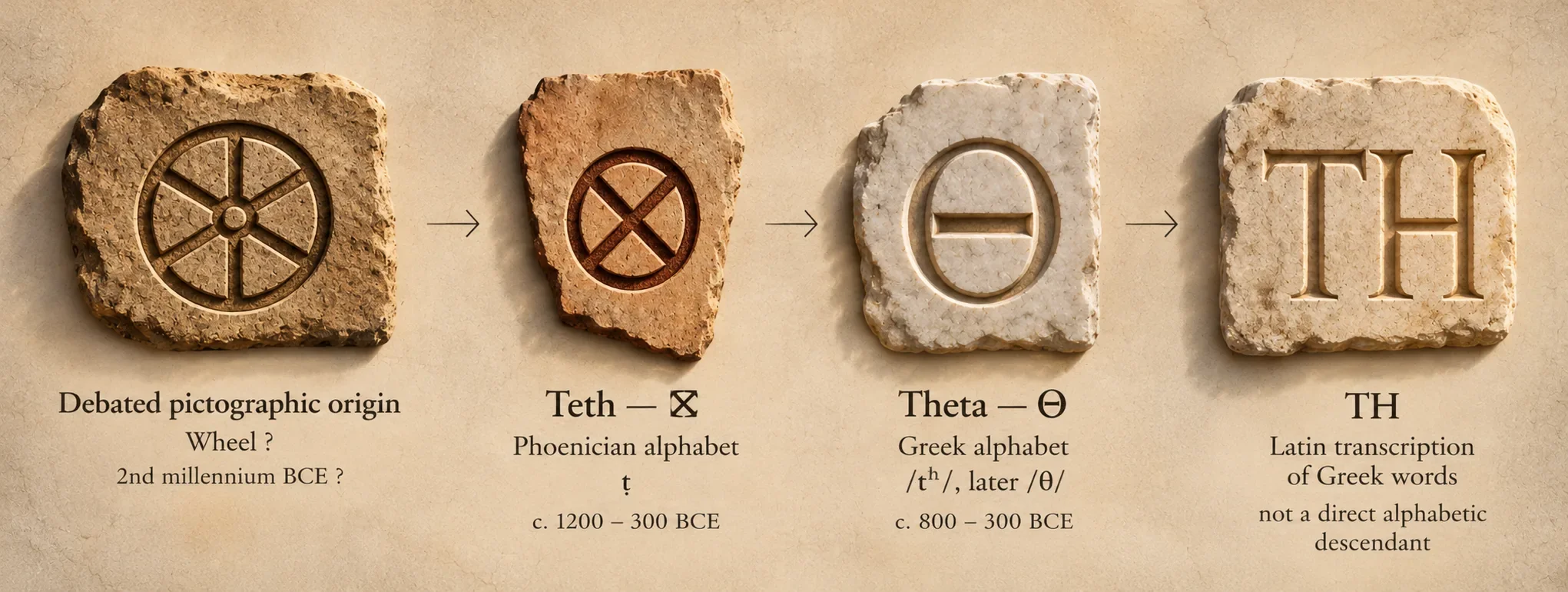
From Teth to Theta
When the Greeks adapted a Semitic alphabet to their own language, they also adopted Teth.
The letter became:
Theta — Θ
Its phonetic function, however, changed.
The Semitic emphatic consonant did not exist in Greek in the same form. The sign was therefore reused for an aspirated consonant, pronounced /tʰ/ in Classical Greek — essentially a t released with a breath of air.
Over the course of Greek history, this pronunciation changed. Theta eventually came to represent the fricative /θ/, the sound still heard in Modern Greek and comparable to the English th in think.
The transmission can therefore be summarised as:
Teth — 𐤈 → Theta — Θ
This is where its history differs from that of many earlier letters in the series.
Latin did not adopt Theta as a regular letter of its alphabet. In words borrowed from Greek, the Romans represented Θ with the digraph:
TH
We should therefore not write:
Teth → T
The Latin T belongs to another lineage: that of Taw — 𐤕.
Teth and Byblos
In Byblos, Teth appears within the name of one of the city’s kings.
The inscription of Šipiṭbaʿal, discovered in 1945, belongs to the group of archaic royal inscriptions from Byblos.
The inscription is generally dated to the beginning of the first millennium BCE and records the name of the king from its opening line:
ŠPṬBʿL — Šipiṭbaʿal
The third consonant, Ṭ, corresponds to Teth — 𐤈.
The inscription identifies Šipiṭbaʿal as king of Byblos, son of Elibaal and descendant of Yehimilk. It commemorates the rebuilding of a wall for the Lady of Byblos and asks the goddess to prolong the king’s days and years over the city.
Teth is therefore not simply a letter preserved in an alphabetic chart.
In Byblos, it appears within the name of a king, carved into stone at the beginning of the first millennium BCE.
Conclusion
With Teth, the transmission of the alphabet follows a different path.
Its pictographic origin remains uncertain. The association with a wheel is a hypothesis, not an established identification.
Its Phoenician function is much clearer: Teth — 𐤈 is the ninth letter of the alphabet and represents an emphatic consonant transliterated ṭ.
In the Greek world, it became Theta — Θ and acquired a new phonetic value.
Teth — 𐤈 → Theta — Θ
Unlike many of the letters we have followed so far, however, Teth did not produce a regular letter of the Latin alphabet.
Latin represented Greek Theta with TH.
And our modern T follows a different history, descending from Taw.
Teth is therefore another reminder that the history of the alphabet is not a sequence of perfect one-to-one correspondences: letters can change sound, disappear from one tradition, or continue without leaving a direct descendant in another alphabet.
Sources and references
Ignace J. Gelb — A Study of Writing
A major work on the history of writing systems. Gelb stresses the difficulty of identifying the pictographic prototypes of several Semitic letters and includes Teth among the letter names whose original meaning remains difficult to explain.
The Unicode Consortium — Phoenician
Reference documentation identifying TET — 𐤈 as the ninth Phoenician letter and documenting its historical relationship with Greek Theta, without a corresponding regular Latin descendant.
DEAPS — Digital Editions of Aramaic and Phoenician Sources, KAI 007
Academic edition of the royal inscription of Šipiṭbaʿal from Byblos. The royal name ŠPṬBʿL contains the consonant Ṭ corresponding to Teth.