

From the mountains to the Mediterranean
In Byblos, the eye naturally turns towards the sea.
Yet an essential part of the city's history begins in the opposite direction.
Behind the coast rises Mount Lebanon. For thousands of years, its forests provided the societies of the Near East with resources sought far beyond the mountains. Among them, cedar wood held a particular place.
Two worlds had to be connected: the trees growing at altitude and the ships waiting on the coast.
Byblos stood between them.
Its history therefore extends beyond the walls of the ancient city. It continues through the valleys, highlands and forests of its hinterland, before reaching the Mediterranean.
The cedar, in human memory
The Lebanon cedar (Cedrus libani) is a mountain tree.
It grows slowly, lives across generations and can reach considerable dimensions. In a landscape where civilizations have followed one another, it introduces another measure of time.
A forest, however, is never simply a collection of trees.
It is a living environment in which plants, animals, soils, water and microorganisms coexist. Cedar itself never formed the Lebanese forest alone: oaks, pines, junipers and other species accompany it across landscapes that change with altitude, exposure and terrain.
Yet the cedar acquired a particular status.
Its timber, its scale, its longevity and the symbols attached to it placed the tree at the heart of religious, political and commercial narratives for several millennia.
It is at once a tree, a material and a memory.
The timber of Lebanon
In Antiquity, timber was a valuable resource.
It was used for construction, roof structures, furniture, monumental buildings and ships. Some regions of the Near East — Egypt in particular — had few large trees capable of providing the long pieces of timber required for such purposes.
The mountains of the Levant therefore became an important source of supply.
Among the woods coming from these mountains, Lebanon cedar became the most celebrated, although ancient texts do not always allow the different conifer species they mention to be identified with certainty.
But between the forest and the kingdoms seeking this timber stood roads, people and ports.
Byblos was one of those ports.
Byblos and Egypt, a relationship across millennia
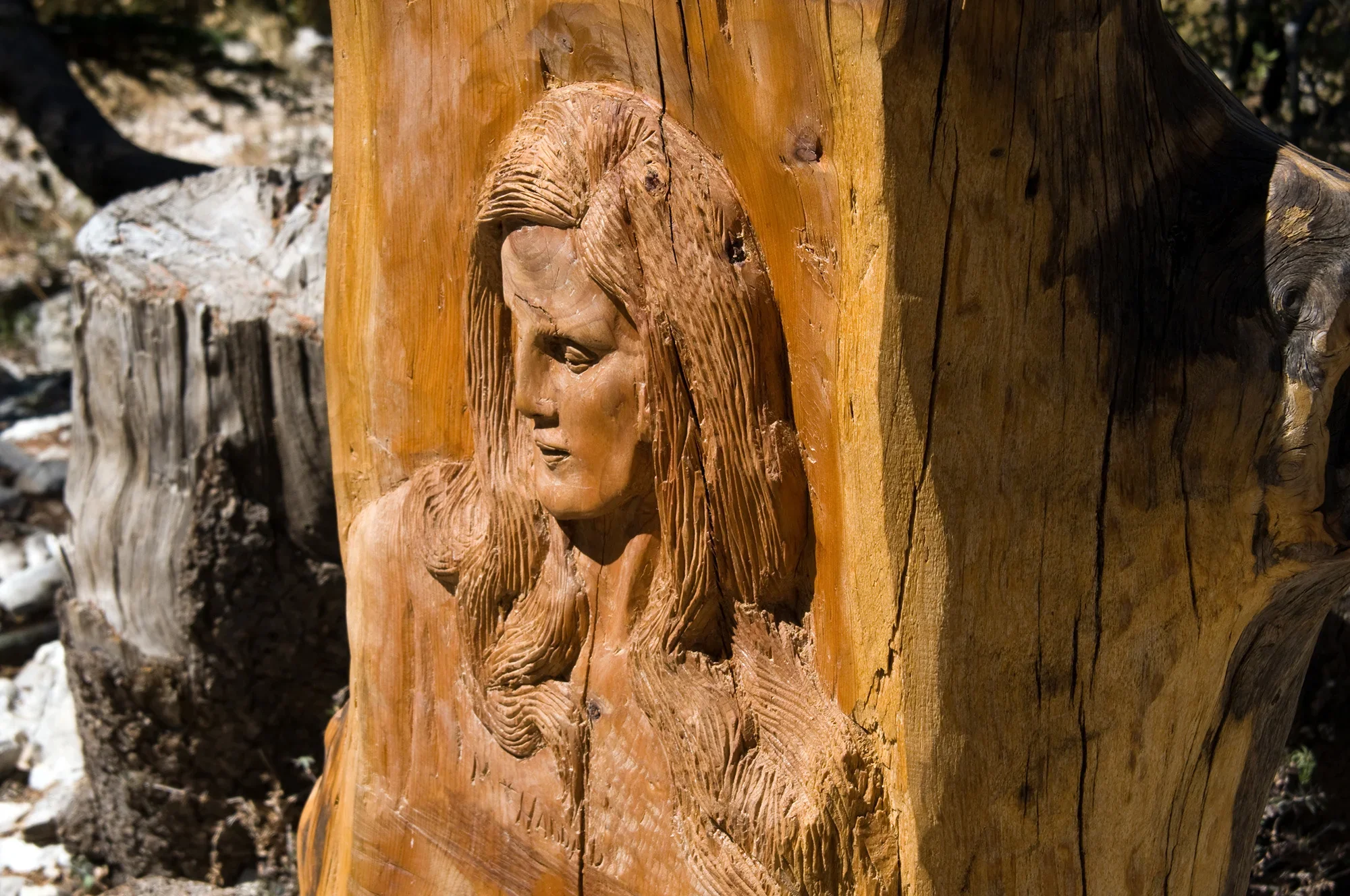
Carved cedar trunk in Al Arz Nature Reserve in Tannourine, Lebanon
Long before Phoenician sailors travelled across the wider Mediterranean, Byblos had already developed close relations with Egypt.
From the third millennium BC onwards, the city emerged as a privileged partner of the pharaohs. Timber from Lebanon formed part of these exchanges, alongside other materials and objects moving between the Levantine coast and the Nile Valley.
This relationship went beyond trade.
Archaeological excavations at Byblos have revealed objects, inscriptions and artistic forms that bear witness to enduring connections with Egypt. The city's rulers maintained political and symbolic relations with the Egyptian world, while the cult of Baalat Gebal itself reflects this long dialogue between the two shores.
Timber nevertheless remains one of the oldest and most tangible threads in this relationship.
Egypt sought in the mountains of Lebanon what its own landscape could provide only with difficulty: large timbers for construction, roof structures, furniture and vessels.
Byblos became one of the points of passage between two profoundly different landscapes.
On one side, the forests of Mount Lebanon.
On the other, the Nile Valley.
Between them, the Mediterranean.
Centuries later, around the eleventh century BC, the Egyptian narrative known as the Journey of Wenamun still preserves the memory of this relationship. An envoy from the Temple of Amun travels to Byblos to obtain timber for the construction of a sacred barque.
The text belongs to a much later period than the earliest documented exchanges between Byblos and Egypt, but it reveals how deeply the association between the city, the timber of Lebanon and the Egyptian world was rooted in time.
In Byblos, the mountains meet the sea.
And across the sea, Egypt.
From the mountains to the harbour
The timber trade reveals another geography of Byblos.
The great trees did not grow beside the ships. They had to be felled in the mountains, prepared, moved and brought down towards the coast.
The harbour city therefore depended on routes connecting the highlands to the Mediterranean.
These movements are more difficult to reconstruct than the monuments preserved on the archaeological site. Ancient texts often refer simply to Lebanon or its mountains, without allowing us to identify precisely, according to today's geography, the forest from which each shipment originated.
Even the names used for different types of wood in Egyptian and Near Eastern sources require caution: cedar, pine, fir and juniper are not always distinguished in the way we would distinguish them today.
One essential fact nevertheless remains.
Behind the harbour of Byblos lay a vast territory whose resources sustained the city's exchanges.
Jaj, the mountains behind Byblos
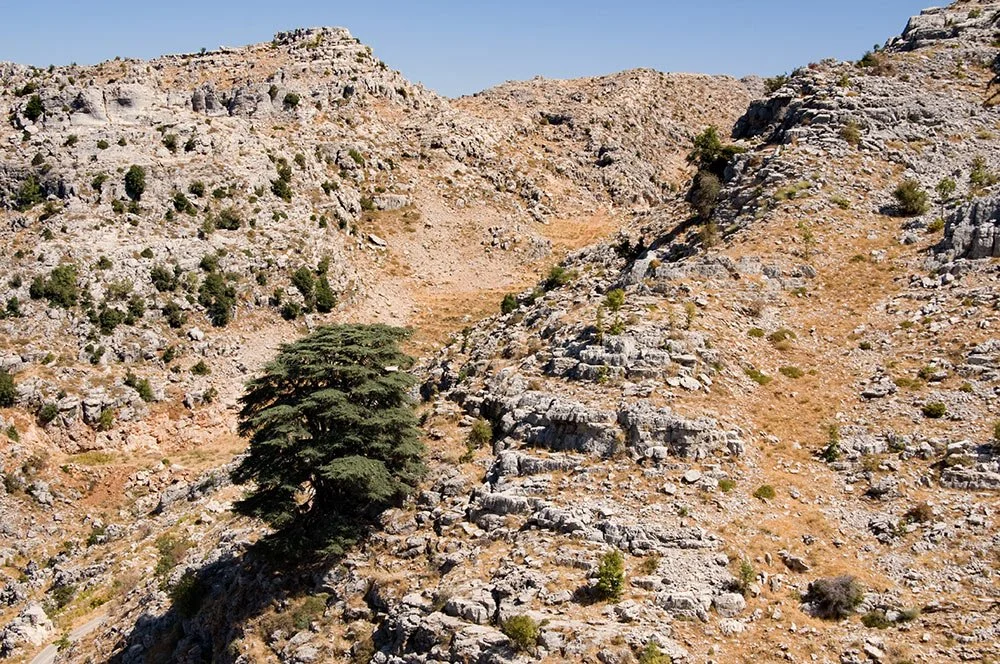
Among the cedar forests that survive today, Jaj has a particularly clear connection with Byblos.
In the highlands of the Jbeil district, cedars emerge from a strongly mineral landscape. At times, the trees seem to grow directly from the rock.
UNESCO documentation concerning Byblos and its hinterland explicitly refers to cedar timber being transported from the forests of Jaj to the harbour of Byblos, before being exported towards Palestine or Egypt.
This gives the landscape another depth.
Only a few dozen kilometres from the coast, the forest belonged to the same territorial system as the ancient harbour.
Byblos did not only face the sea.
It also looked towards the mountains.
Bsharri, a forest of survivors
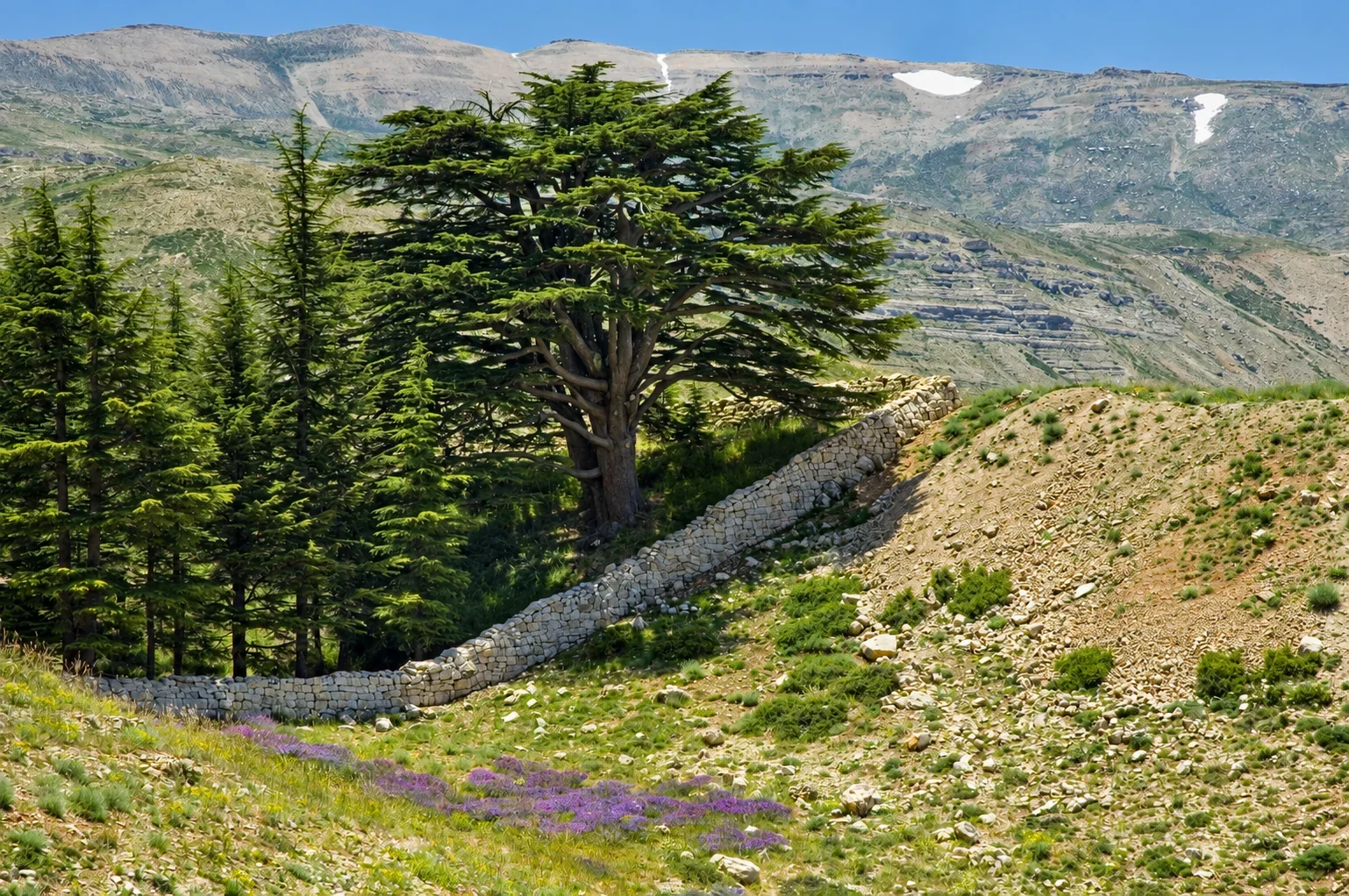
Further north, below the summits of Mount Lebanon, the Cedars of God at Bsharri now form a forest far smaller than the great wooded landscapes evoked by ancient sources.
A forest of survivors.
Perhaps no other expression better conveys the character of the place.
The trees that remain preserve the memory of a much larger forest landscape. UNESCO describes them as survivors of an ancient sacred forest whose timber ranked among the most sought-after building materials of the ancient world.
The forest also overlooks one of Lebanon's most powerful landscapes: the Qadisha Valley. The river rises below the cedars before entering a deep valley inhabited for centuries by monastic communities.
Here, the cedar cannot be separated from the mountain surrounding it.
The sources extensively document the ancient exploitation of Lebanon's forests and the role of Byblos in the timber trade. They do not, however, always allow individual shipments leaving the harbour to be assigned to a forest defined by today's geographical boundaries.
Bsharri should therefore be understood not as an artificially designated source for all timber exported through Byblos, but as one of the major surviving witnesses to the forest world on which the coastal ports depended.
Tannourine, the forest among the rocks
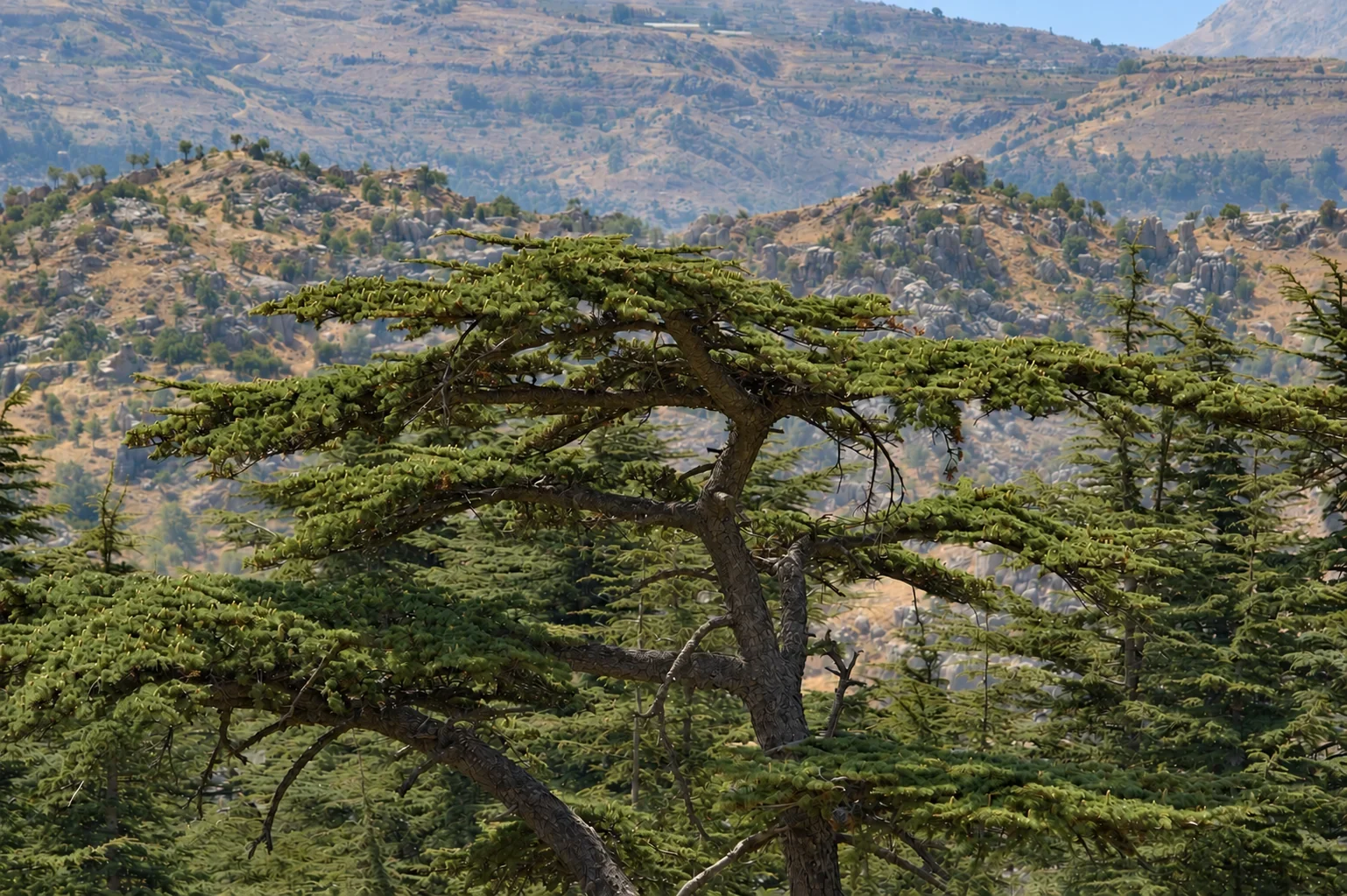
At Tannourine, the relationship between vegetation and stone changes once again.
The forest forms a mass of green within a rugged mountain landscape. Here the cedar is not simply an isolated or monumental tree: it belongs to a dense ecosystem clinging to the slopes.
Its apparent strength should not conceal its vulnerability.
The Tannourine forest has notably experienced a serious infestation by an insect now named Cephalcia tannourinensis, a reminder that an ancient ecosystem can be deeply disrupted within only a few years.
Tannourine offers another way of looking at the cedar.
Not simply as a national symbol or a historical material, but as a living species dependent upon a complex balance of altitude, climate, soil and other forms of life.
The Shouf, another scale
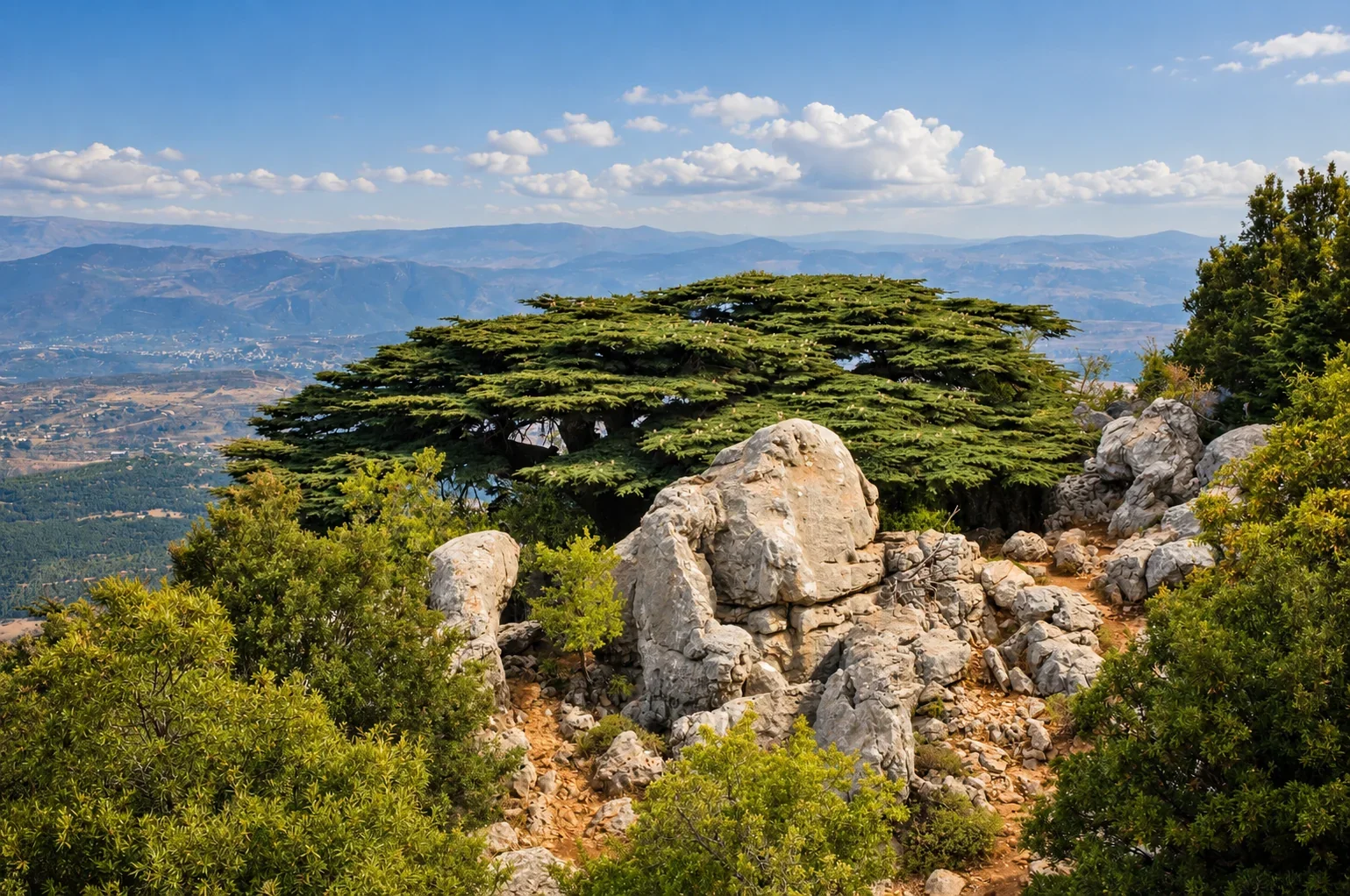
Further south in Mount Lebanon, the landscape changes again.
The cedar forests of the Shouf belong to a much larger territory, where cedar forms part of a mosaic of forests and natural habitats.
Ain Zhalta, Maasser el-Shouf, Barouk: here the cedar accompanies a landscape stretching across long mountain slopes, where conservation today extends well beyond a handful of remarkable trees.
The historical relationship between these southern forests and the harbour of Byblos is less direct and should not be assumed.
The Shouf nevertheless belongs naturally within this story.
It reminds us that the cedar belongs neither to a single city nor to a single valley. Its geography extends across a large part of the Lebanese mountains.
Moving from Jaj to Tannourine, Bsharri and the Shouf therefore does not mean encountering the same forest four times.
It reveals four different ways in which the cedar inhabits the mountains.
Forests coveted, then protected
The value of these trees also contributed to their vulnerability.
For centuries, the forests of Lebanon were exploited for timber. By the Roman period, this resource had become strategic enough for Emperor Hadrian to have forest estates demarcated across Mount Lebanon.
Inscriptions carved directly into the rock marked these imperial domains and regulated the exploitation of several valuable tree species.
These boundary inscriptions form an unusual trace in the landscape.
They show that by the second century AD, the forest was already regarded both as a resource to be controlled and as a territory to be administered.
Exploit. Delimit. Protect.
These three gestures continue to run through the history of Lebanon's forests.
Behind the city, a landscape
Byblos is often told through its monuments.
The Bronze Age temples, royal tombs, fortifications, Roman roads, castle and harbour offer a history that can immediately be seen.
The cedar asks us to look further.
It invites us to leave the promontory, climb towards the valleys and place the city within a much wider territory.
Behind the ships, there were trees.
Behind the harbour, paths.
Behind the exchanges, a mountain.
This relationship between the city and its hinterland helps explain part of what made Byblos significant: its ability to connect territories that did not meet directly.
Mountain and sea.
Timber and ship.
Lebanon and Egypt.
The cedar remains one of the threads connecting these worlds.
Sources and references
UNESCO World Heritage Centre — Byblos.
Documentation on the Outstanding Universal Value of Byblos, its history and territory.
UNESCO World Heritage Centre — Partnerships for World Heritage Cities: Culture as a Vector for Sustainable Urban Development, World Heritage Papers 9.
Documentation on the historical relationship between Byblos and its hinterland, including the transport of cedar timber from Jaj to the harbour of Byblos.
Morhange, C. et al. — “Proposition de localisation des ports antiques de Byblos (Liban)”, Méditerranée, 2000.
Study of the ancient harbour system of Byblos and its role in exchanges with Egypt.
Grimal, N. and Francis-Allouche, M. — “Nouvelles recherches archéologiques à Byblos”, Comptes rendus de l’Académie des Inscriptions et Belles-Lettres, 2012.
Research on Byblos, its relationship with Egypt and the identification of woods mentioned in ancient sources.
UNESCO World Heritage Centre — Ouadi Qadisha (the Holy Valley) and the Forest of the Cedars of God (Horsh Arz el-Rab).
Documentation on Bsharri, the Qadisha Valley and the cedars preserved as survivors of an ancient sacred forest.
Breton, Jean-François — Les inscriptions forestières d’Hadrien dans le Mont Liban, Bibliothèque archéologique et historique, 1980.
Study of the demarcation of imperial forest estates in Mount Lebanon under Hadrian.
Lebanese Ministry of Environment — Tannourine Cedars Forest Nature Reserve.
Institutional documentation on the reserve and the forest ecosystem of Tannourine.
UNESCO — Man and the Biosphere Programme, Shouf Biosphere Reserve.
Documentation on the cedar forests and natural landscapes of the Shouf Biosphere Reserve.
Bassil, Melkan — At the Heart of Our Forests.
Photographic and editorial work devoted to Lebanon's forests, including the cedar forests of Bsharri, Tannourine and the Shouf, and to the relationship between landscape, natural heritage and memory.
Visit Byblos aims to provide documented content based on identified sources. Some information may nevertheless evolve as research advances and new discoveries are made. Documented corrections or additional information are welcome.