
Write your name in the Phoenician alphabet (interactive tool)
Enter your first name and discover a transcription inspired by the Phoenician alphabet, one of the oldest alphabetic writing systems of the Mediterranean world.
Each result is a simplified phonetic interpretation based on the sounds of your modern name.
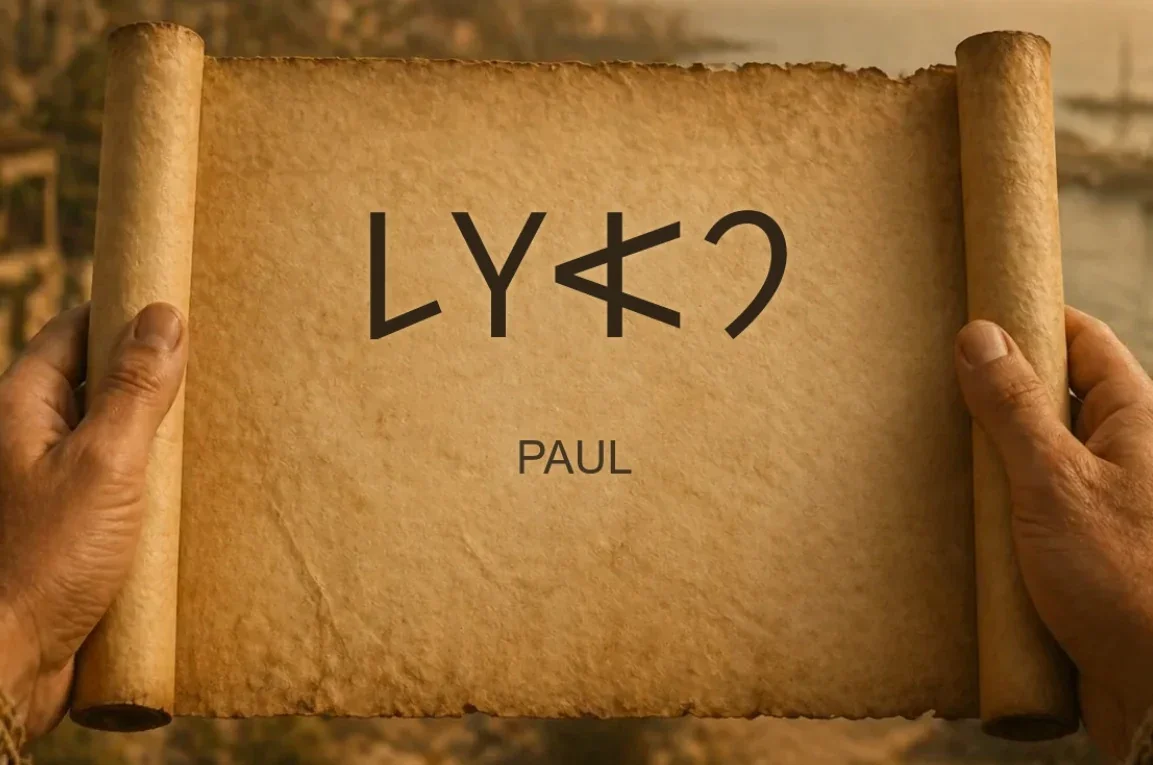
Your card has been downloaded.
Remember to send it to your friends and family.
Did you enjoy the experience? Share it:
Understanding What You Just Generated
The Phoenician alphabet works differently from modern alphabets.
Used across the eastern Mediterranean more than 3,000 years ago, it mainly recorded consonants and was generally written from right to left.
Vowels were often implicit and depended on context or oral transmission.
Modern names therefore need to be adapted phonetically.
The result generated here is not an exact historical transcription, but an interpretation inspired by the way the Phoenician writing system functioned.
An Ancient System Applied to a Contemporary Name
Writing a modern first name using an ancient alphabet necessarily involves interpretation.
Some sounds used today did not exist in ancient Semitic languages.
Other letters must be simplified or associated with equivalent sounds.
This tool offers a visual and educational approach to discovering how the Phoenician writing system worked through an interactive experience.
Questions About Phoenician Writing
-
Not exactly.
This tool generates a simplified phonetic transcription inspired by the Phoenician alphabet rather than a historically exact translation. -
The Phoenician writing system mainly recorded consonants.
Vowels were often implied and understood through context and oral tradition. -
Yes.
The Phoenician alphabet strongly influenced the Greek alphabet, which later gave rise to the Latin alphabet used in many modern languages today. -
Yes.
Like many ancient Semitic writing systems, Phoenician was generally written and read from right to left. -
Some of the oldest known Phoenician inscriptions were discovered in Byblos, including the inscription on the sarcophagus of King Ahiram, now preserved at the National Museum of Beirut.