
The Phoenician alphabet — The invention that simplified writing
What is the Phoenician alphabet?
The Phoenician alphabet is a writing system made up of 22 signs, each representing a consonant.
It emerged on the shores of the Mediterranean, notably in Byblos, in present-day Lebanon, and is considered one of the earliest alphabetic systems in history.
Unlike Egyptian hieroglyphs or Mesopotamian cuneiform, it does not represent words or ideas, but sounds.
It is one of the first systems to simplify writing and enable its wide transmission across cultures.
Before letters
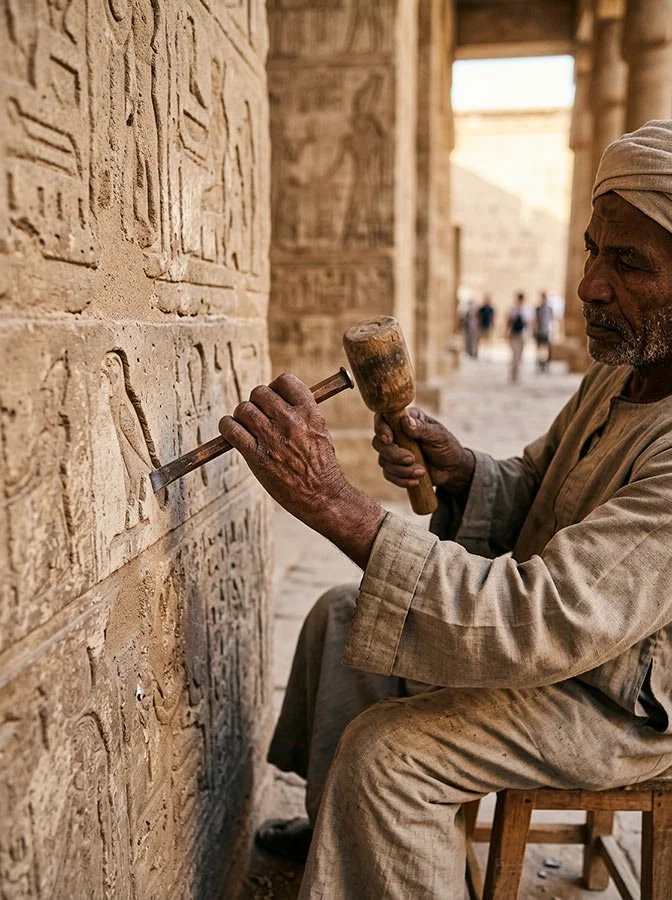
Before the alphabet, writing was the work of specialists.
In Egypt, hieroglyphs required years of learning.
In Mesopotamia, cuneiform signs accumulated on clay tablets.
Each word was a symbol.
Each symbol was a memory to retain.
Writing was not primarily about transmission.
It was about mastery.
In such systems, few people could read.
Even fewer could write.
Knowledge circulated slowly, under control and in restricted circles.
A change of principle
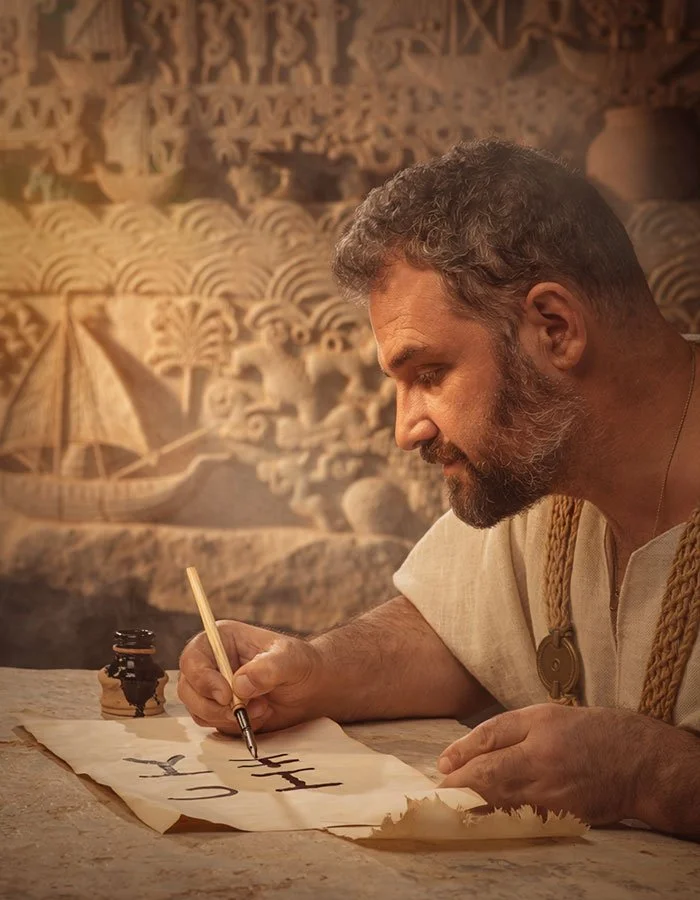
Then another logic appeared — in Byblos, a port city at the crossroads of exchanges between Egypt and the Mediterranean world.
A limited number of signs could now compose an infinite number of words.
That shift changes everything.
Writing becomes lighter, more mobile, easier to learn and easier to transmit.
The Phoenician alphabet is made up of 22 signs.
These 22 consonantal letters form one of the earliest alphabetic systems in history.
It is written from right to left and mainly records consonants.
Vowels are not written: they remain implicit, carried by the language itself.
This system is more economical, quicker, and more effective for mercantile and administrative uses.

Signs that travel
From the Phoenician ports, the system spreads.
It passes through Byblos, Tyre, and Sidon.
It crosses the sea, reaches Greece, and then Rome.
At each stage, it changes.
Letters evolve, alter their shapes, and adapt to new languages.
But the principle remains.
One sound = one sign.
That principle will give rise to the alphabets we use today.
Without knowing it, these navigators established a structure far greater than their own time.
Because of its simplicity, the system could travel with merchants, sailors, and traders, no longer confined to temples or royal administrations.
A discreet invention, a lasting effect
The Phoenician alphabet does not tell only an ancient story.
It continues to shape the way we write, read, and transmit.
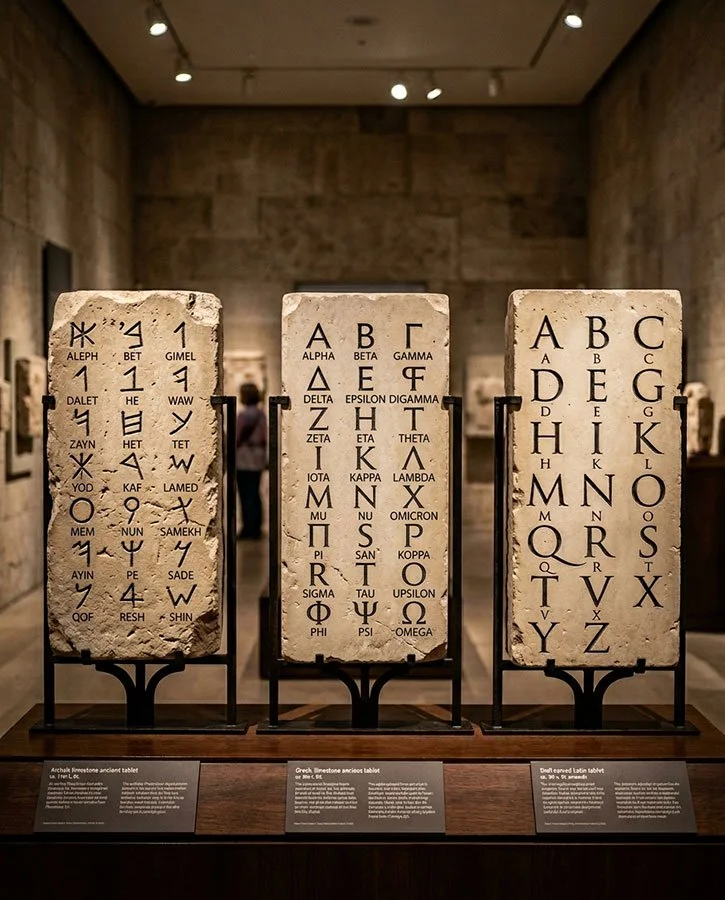
What emerged here was a shift in structure. A system reduced to a limited number of signs, where each symbol represents a sound.
From this principle, other alphabets developed. The Greek alphabet, then the Latin alphabet we use today, all inherit this same logic.
The letters on this page — A, B, C — are distant descendants of those first signs. Their forms have changed, their sounds have evolved, but the system remains.
What we are looking at here is not an isolated relic.
It is a structure that is still active.
Each time a word is written, each time a thought is fixed into letters, it extends, quietly, this invention born here thousands of years ago.
What emerged here, on the shores of Byblos in present-day Lebanon, continues to structure the way writing works across much of the world.
Why the Phoenician alphabet still matters
The Phoenician alphabet is not just an early writing system.
By reducing writing to a limited set of signs, it changes how information can be transmitted.
What was once restricted to trained specialists becomes more accessible, more flexible, and easier to reproduce.
This principle spreads across the Mediterranean and is adopted, adapted, and transformed. The Greek alphabet, then the Latin alphabet, inherit this same structure.
Today, a large part of the world still writes using systems based on this model.
What began here, in Byblos, is not a closed chapter of history. It is a structure that remains active.
Common questions about the Phoenician alphabet
-
Because it only records consonants, reducing the number of symbols needed.
-
Vowels are implicit and carried by spoken language.
-
In Phoenician cities such as Byblos, Tyre, and Sidon, and later across the Mediterranean.