
Yod — 𐤉
Tenth letter of the Phoenician alphabet.

Before I, there was Yod.
Yod is the tenth of the twenty-two letters of the Phoenician alphabet.
In this consonantal writing system, it represents the sound /j/ — similar to the initial sound in the English word yes.
The name Yod is closely associated with the hand. This connection is more securely established than some of the pictographic interpretations encountered with letters such as Teth, Heth or Zayin. Semitic forms such as yod and yad refer to the hand, while reconstructions of the earliest alphabetic signs connect its graphic ancestor with an Egyptian sign depicting an arm or forearm.
The precise path from image to letter remains reconstructed, however.
What follows is much clearer. When the sign was adopted into Greek, Yod — 𐤉 became Iota — Ι and changed function: a Semitic consonant became the Greek vowel /i/.
From Iota eventually came the Latin I.
The letter J belongs to the same history, but only much later.
A hand at the beginning?
Several early alphabetic signs appear to preserve the memory of images taken from the visible world.
In the case of Yod, the connection with the hand is ancient and well documented.
The Semitic name of the letter is associated with the word for “hand”, while reconstructions of the Proto-Sinaitic script connect its ancestor with an Egyptian hieroglyph depicting an arm or forearm. Through the acrophonic principle, that image could be associated with the initial sound of the Semitic word for hand.
Here again, however, two levels of certainty should be kept separate.
The relationship between the name Yod and the hand is well established; the exact form of the earliest pictographic ancestor remains reconstructed from the surviving evidence.
What is certain in the Phoenician alphabet is the function of the letter: Yod — 𐤉 occupies the tenth position and represents the consonant /j/.
By this stage, the image has become a letter.
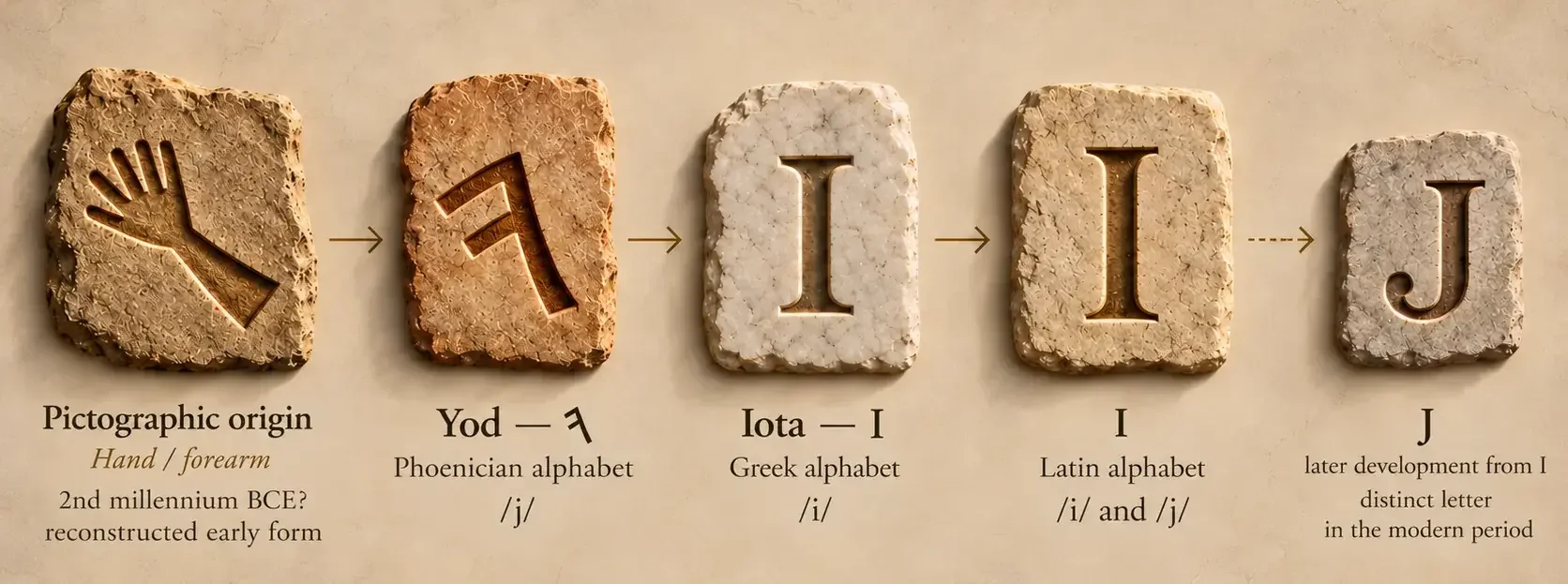
From Yod to Iota, then I
When the Greeks adapted the Phoenician alphabet to their own language, they also adopted Yod.
It became:
Iota — Ι
But its role changed.
Phoenician Yod represents the consonant /j/. Greek Iota, by contrast, was used for the vowel /i/.
This transformation belongs to one of the major innovations of the Greek alphabet: several Semitic consonantal signs were reassigned to represent vowels needed by the Greek language.
Iota was later transmitted through the alphabets of ancient Italy and into Latin, where it became:
I
In Classical Latin, the same letter could represent both the vowel /i/ and a consonantal value /j/.
There was no independent letter J.
Only much later did a lengthened or curved form of I begin to develop as a graphic variant in medieval writing. The distinction between I and J as separate letters with different functions emerged gradually and became established in the modern period.
The main lineage can therefore be summarised as:
Yod — 𐤉 → Iota — Ι → I
followed, much later, by:
I → J
It would therefore be misleading to present I and J as two parallel ancient descendants of Yod.
J belongs to the same lineage, but through the Latin I and on a very different timescale.
Yod and Byblos
In Byblos, Yod appears prominently in one of the city’s royal inscriptions.
The inscription of King Yehimilk belongs to the group of archaic royal texts from Byblos and is generally dated to the early first millennium BCE.
The king’s name appears from the opening line:
YḤMLK — Yeḥimilk
Its first consonant is Yod — 𐤉.
The inscription presents Yehimilk as king of Byblos and records works that he states he built or restored in the sanctuaries of the city. The text then invokes Baalshamem, the Lady of Byblos and the sacred gods of Byblos, asking them to prolong the king’s days and years over the city.
Yod therefore appears here not as part of an alphabet exercise, but at the beginning of a royal name carved into stone.
In Byblos, the letter belongs to the language of kings, buildings and divine protection at the beginning of the first millennium BCE.
Conclusion
Yod is a small sign with a remarkably long history.
Its name is associated with the hand, while its earliest graphic ancestor is reconstructed from a sign representing an arm or forearm.
In Phoenician, Yod — 𐤉 represents the consonant /j/.
In Greek, it became Iota — Ι and was reassigned to the vowel /i/.
From Iota came the Latin I.
Yod — 𐤉 → Iota — Ι → I
The J appeared only much later, when a graphic variant of I gradually developed into a separate letter.
The history of Yod therefore connects a Phoenician consonant, a Greek vowel and two letters of modern alphabets — but across very different periods of time.
Sources and references
Ignace J. Gelb — A Study of Writing
A major reference on the history of writing systems. Gelb discusses the relationship between the Semitic letter name Yod, associated with the hand, and Greek Iota, within the broader transmission from Semitic to Greek alphabets.
Anshuman Pandey — Revisiting the Encoding of Proto-Sinaitic in Unicode
A comparative study of Proto-Sinaitic signs and their proposed Egyptian prototypes. Its tables connect the Egyptian forearm sign with Semitic yad, “hand”, and with the later sequence leading to Yod and Iota.
DEAPS — Digital Editions of Aramaic and Phoenician Sources, KAI 004
Academic edition of the Yehimilk inscription from Byblos. The royal name YḤMLK begins with Yod, and the inscription is dated palaeographically to approximately 950–920 BCE.
History of I and J
Studies of historical orthography document j as a later graphic development of i, gradually becoming specialised and eventually recognised as a separate letter long after Antiquity.