
Kaph — 𐤊
Eleventh letter of the Phoenician alphabet.

Before K, there was Kaph.
Kaph is the eleventh of the twenty-two letters of the Phoenician alphabet.
In this consonantal writing system, it represents the sound /k/.
The name Kaph is associated with the palm of the hand. This connection is well documented in Semitic languages and fits one of the standard reconstructions of the earliest alphabetic signs: an image of a hand or palm may have been reinterpreted acrophonically to represent the initial sound /k/. Publications from the Institute for the Study of Ancient Cultures in Chicago use Kaph as a clear example of this process.
The exact graphic path from those early signs of the second millennium BCE to the Phoenician letter remains reconstructed.
What follows is much better documented.
Kaph — 𐤊 was adopted into Greek as Kappa — Κ, then passed through the alphabets of ancient Italy into Latin, where it became K.
From the palm to the letter
The earliest alphabets drew in part on familiar images, but used them not to represent the objects themselves, rather to encode sounds.
Kaph is a particularly clear example.
The Semitic word associated with the name of the letter refers to the palm or hand. In reconstructions of Proto-Sinaitic, a sign inspired by an Egyptian hand sign is linked to the sound /k/ through the Semitic word kaph.
We can therefore be more confident here than with Teth or Zayin, while still keeping the distinction between what is documented and what is reconstructed.
The connection between the name Kaph and the palm is well established; the exact shape of its earliest pictographic ancestor remains reconstructed from the surviving evidence.
In the Phoenician alphabet itself, the picture is much clearer: Kaph — 𐤊 occupies the eleventh position and represents the consonant /k/.
By this stage, the image had become a letter.
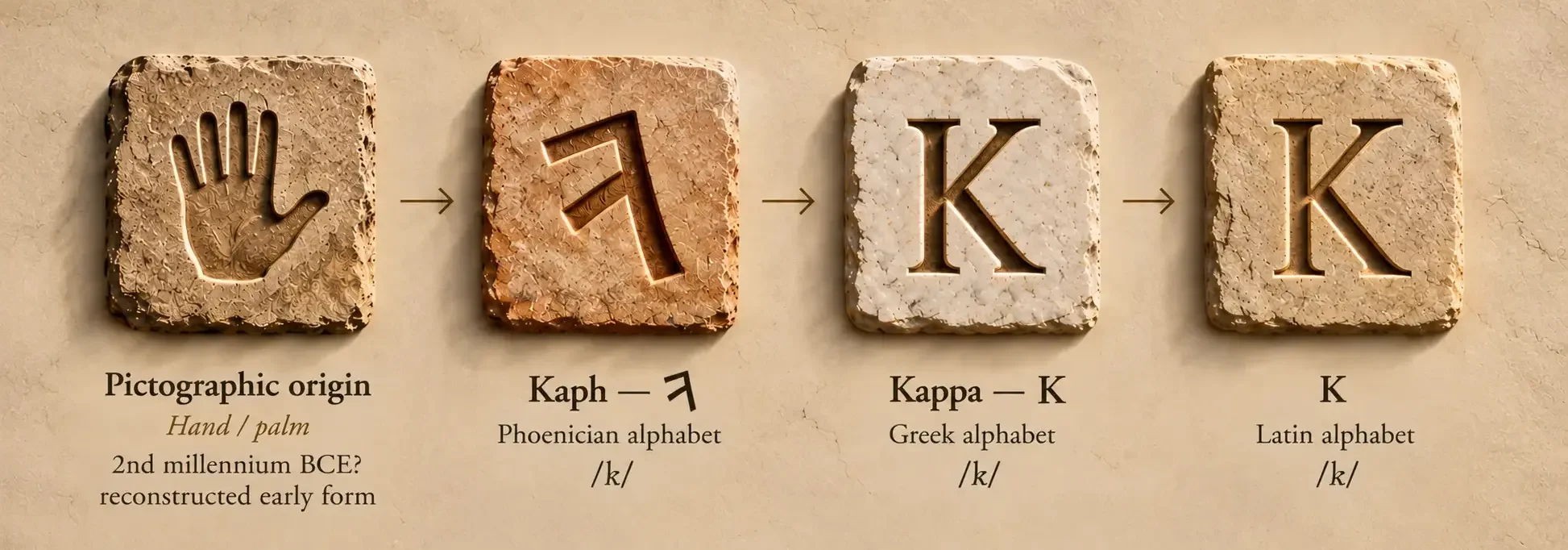
From Kaph to Kappa, then K
When the Greeks adapted the Phoenician alphabet to their own language, they also adopted Kaph.
The letter became:
Kappa — Κ
It retained the consonantal value /k/.
Its shape changed relatively little. Over time, the Greek sign developed the angular form still recognizable in Kappa and in the Latin K.
Its position in the alphabet, however, shifted. Kaph is the eleventh letter of the Phoenician sequence, while Kappa is the tenth letter of the modern Greek alphabet, partly because some archaic Greek letters later disappeared from the sequence. The broader order of the Greek alphabet nevertheless remains inherited from the Semitic model.
Kappa then passed through the alphabets of ancient Italy and into Latin:
Kaph — 𐤊 → Kappa — Κ → K
The Latin K has its own particular history.
It appears in early Latin inscriptions, but was soon largely displaced by C, which became the normal way of writing the sound /k/. K survived mainly in a limited number of traditional spellings, such as Kalendae.
Unlike Teth, then, Kaph has a direct Latin descendant:
the modern K belongs directly to the lineage of Kaph.
Kaph and Byblos
In Byblos, Kaph appears in a particularly interesting royal inscription — not only as a letter in the text, but also as a sign whose archaic form complicated the history of its modern decipherment.
The inscription of King Abibaal, catalogued as KAI 005, is engraved on the base of a statue bearing the name of the Egyptian pharaoh Sheshonq. DEAPS dates the inscription palaeographically to around 940–930 BCE.
The text identifies Abibaal as:
MLK GBL — king of Byblos
In MLK, the final consonant is Kaph — 𐤊.
The letter therefore appears in one of the most fundamental words of Phoenician royal vocabulary: mlk, “king.”
The inscription also preserves something rarer.
DEAPS notes that the text uses an archaic form of Kaph that was once confused with another letter in early attempts to read the inscription. This palaeographic feature contributed to difficulties in its correct decipherment.
Kaph therefore allows us to see the alphabet from another angle.
Phoenician letters were not always graphically fixed. They could vary enough in form to mislead modern epigraphers.
In Byblos, Kaph belongs both to the language of kingship and to the modern history of deciphering Phoenician writing.
Conclusion
With Kaph, the alphabetic lineage is especially clear.
Its name is associated with the palm of the hand, while the earliest alphabetic evidence supports a reconstructed graphic ancestor related to the hand.
In Phoenician, Kaph — 𐤊 represents the consonant /k/.
The Greeks adopted it as Kappa — Κ, preserving that phonetic value.
Kappa then passed through the alphabets of ancient Italy and became the Latin K.
Kaph — 𐤊 → Kappa — Κ → K
Latin eventually reduced the use of K in favour of C, but the letter never disappeared entirely.
More than three millennia after Kaph, the shape and sound of K still preserve a remarkable continuity with their Phoenician ancestor.
Sources et références
Institute for the Study of Ancient Cultures, University of Chicago — travaux sur les origines de l’alphabet
La publication décrit le principe acrophonique des premières écritures alphabétiques et utilise explicitement Kaph comme exemple : l’image de la main est associée au son /k/ à partir du mot ouest-sémitique désignant la paume ou la main. UChicago ISAC
The Metropolitan Museum of Art — Alphabet Origins: From Kipling to Sinai
Présentation documentaire des inscriptions proto-sinaïtiques, du principe acrophonique et du passage des premières écritures alphabétiques au phénicien puis au grec. The Metropolitan Museum of Art
Oxford Classical Dictionary — alphabet, Greek
Référence sur l’adaptation grecque de l’alphabet phénicien, la conservation de l’ordre sémitique et les modifications ultérieures de la série grecque. OUP Academic
DEAPS — Digital Editions of Aramaic and Phoenician Sources, KAI 005
Édition académique de l’inscription d’Abibaal de Byblos, datée paléographiquement d’environ 940–930 av. J.-C.. DEAPS souligne notamment la présence d’une forme archaïque de Kaph qui avait été mal identifiée lors des premières lectures du texte.