
Lamed — 𐤋
Twelfth letter of the Phoenician alphabet.

Before L, there was Lamed.
Lamed is the twelfth of the twenty-two letters of the Phoenician alphabet.
In this consonantal writing system, it represents the sound /l/.
Reconstructions of the earliest alphabetic signs traditionally connect Lamed with a goadstick, herding staff, or another long rod used to guide animals. This interpretation is well established in the history of scholarship, but the exact pictographic prototype remains uncertain. Recent work on Proto-Sinaitic still presents the identification cautiously, often as “goadstick?”
The later history of the letter is much clearer.
When the Greeks adapted the Phoenician alphabet, Lamed — 𐤋 became Lambda — Λ. It was then transmitted through western Greek and Italic alphabets into Latin, where it became our L.
A staff for guiding animals?
Several early alphabetic signs appear to preserve the memory of everyday objects.
For Lamed, the object most often proposed is a goadstick — a long staff used to guide cattle — or, more broadly, a pastoral staff.
This interpretation has a long scholarly history. Older reference works describe the earliest form of Lamed as a pictogram representing an ox-goad, while more recent reconstructions tend to remain more cautious and mark the identification as hypothetical.
The distinction matters.
The association of Lamed with a goadstick or herding staff is an important reconstruction; the exact object behind the earliest sign is not firmly established.
What is not in doubt in the Phoenician alphabet is its function: Lamed — 𐤋 occupies the twelfth position and represents the consonant /l/.
By this stage, the image had become a letter.
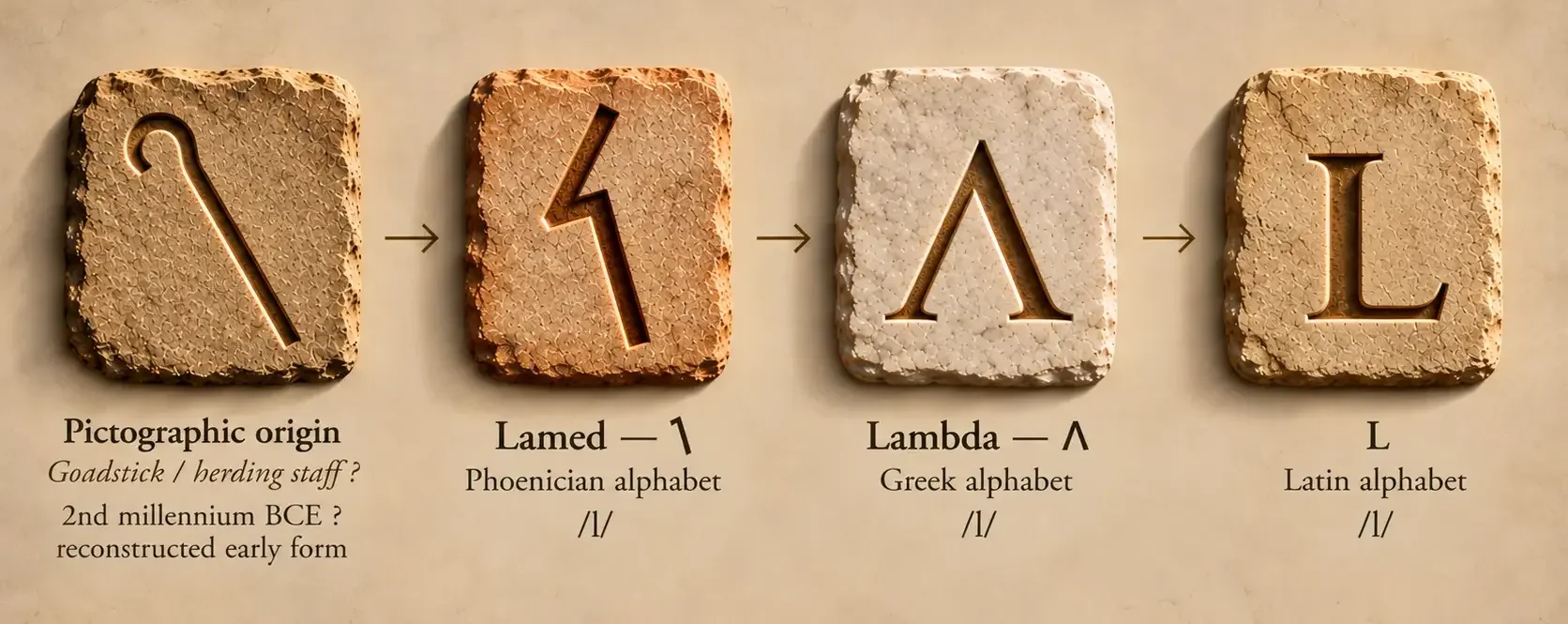
From Lamed to Lambda, then L
When the Greeks adopted the Phoenician alphabet, they also took over Lamed.
The letter became:
Lambda — Λ
It retained the consonantal value /l/.
Lamed is the twelfth letter of the Phoenician alphabet, while Lambda is now the eleventh letter of the Greek alphabet. This shift reflects later changes in the Greek alphabetic sequence, including the disappearance of some archaic letters.
The graphic transmission also deserves some nuance.
Early Greek Lambda did not always have the regular Λ shape familiar today. Archaic Greek alphabets used several orientations and variants of the sign. Some western forms were closer to the shapes later transmitted into Italic scripts and eventually into Latin.
The passage to Latin should therefore not be understood as a simple visual sequence:
Λ → L
It was a transmission through several ancient forms of Lambda, one of which gradually developed into the Latin L.
The historical lineage, however, is clear:
Lamed — 𐤋 → Lambda — Λ → L
And unlike several letters we have encountered earlier, the phonetic value remains remarkably stable throughout:
/l/ → /l/ → /l/.
Lamed and Byblos
In Byblos, Lamed appears in some of the most characteristic expressions found in the city’s royal inscriptions.
The Yehimilk inscription, generally dated to around 950–920 BCE, presents Yehimilk as king of Byblos and belongs to the group of archaic royal inscriptions from the city.
One of the formulas found in the text is:
MLK GBL
meaning:
“king of Byblos”
Lamed appears twice in these six consonants.
In MLK, it is the second consonant.
And in GBL, it is the final consonant.
That second occurrence is particularly important for Visit Byblos: GBL is the ancient Semitic name of Byblos in these royal inscriptions.
If Gimel opens the name GBL, Lamed closes it.
The twelfth letter of the alphabet therefore belongs directly to the way the rulers of the city wrote the name of Byblos at the beginning of the first millennium BCE.
Conclusion
With Lamed, the alphabetic lineage is especially continuous.
Its pictographic prototype is traditionally associated with a goadstick or herding staff, although this reconstruction should remain cautious.
In the Phoenician alphabet, Lamed — 𐤋 represents the consonant /l/.
The Greeks adopted it as Lambda — Λ, preserving the same sound.
Through western Greek and Italic alphabets, it eventually entered Latin as:
L
The lineage can therefore be summarised as:
Lamed — 𐤋 → Lambda — Λ → L
Across more than three millennia, the shape changed, but the sound remained.
And in Byblos, Lamed has a particular resonance: it closes GBL, the ancient name of the city itself.
Sources and references
Anshuman Pandey — Revisiting the Encoding of Proto-Sinaitic in Unicode
A comparative study of Proto-Sinaitic signs and their descendants. The table for Lamed associates its proposed prototype with a “goadstick?”, explicitly preserving the hypothetical nature of the identification.
Encyclopaedia Judaica — “Lamed”
A historical overview of the letter and its graphic development. It presents the traditional prototype as an ox-goad and follows the evolution of early Lamed forms.
The Metropolitan Museum of Art — Alphabet Origins: From Kipling to Sinai
An overview of the acrophonic principle, Proto-Sinaitic inscriptions and the transition from early Semitic alphabets to Phoenician and Greek.
DEAPS — Digital Editions of Aramaic and Phoenician Sources, KAI 004
Academic edition of the Yehimilk inscription, palaeographically dated to approximately 950–920 BCE. The text contains several occurrences of MLK GBL, “king of Byblos,” in which Lamed appears both in mlk and in GBL.