
Samekh — 𐤎
The fifteenth letter of the Phoenician alphabet.
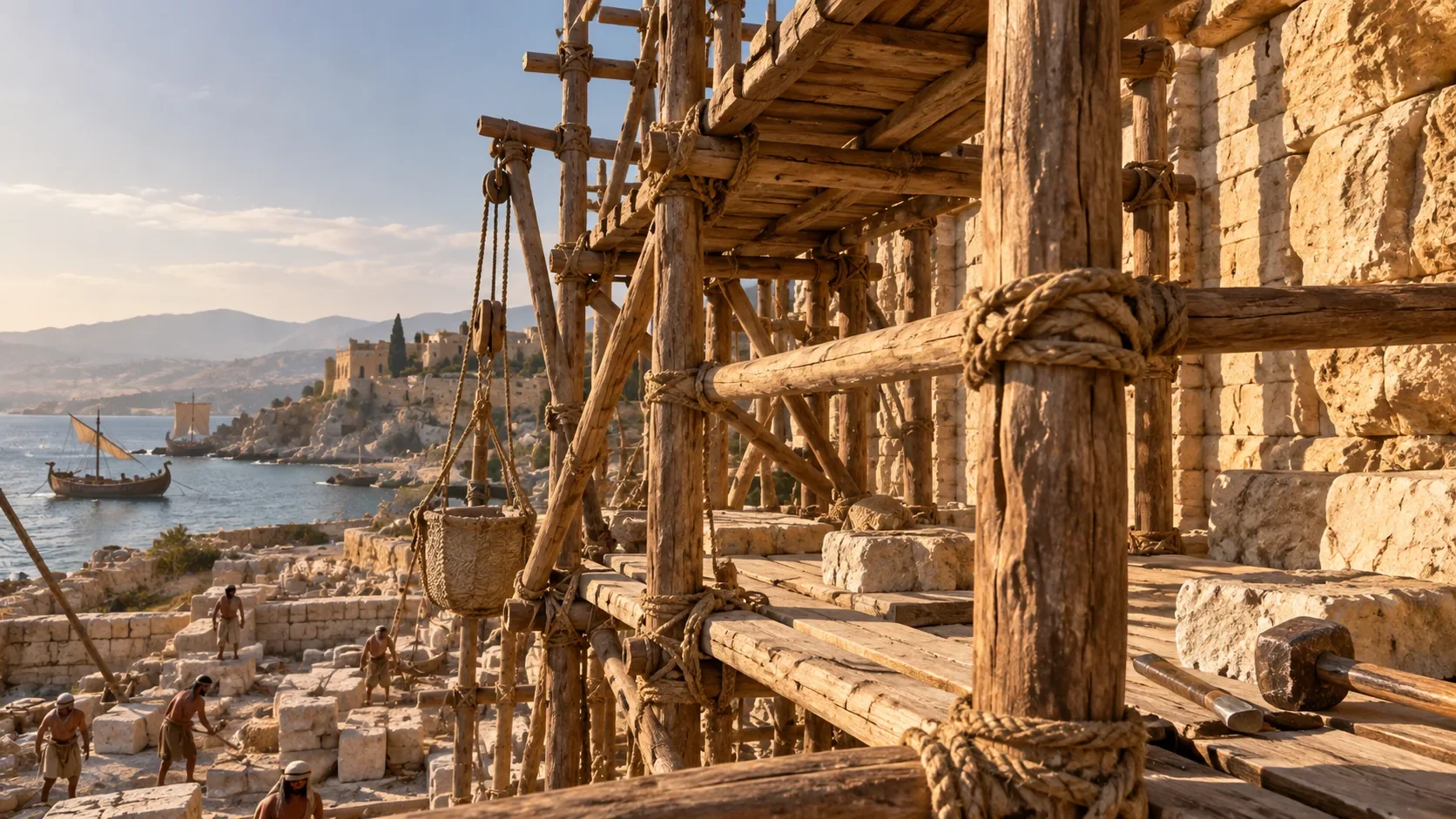
Samekh is the fifteenth of the twenty-two letters of the Phoenician alphabet. In first-millennium BCE Phoenician, it represented a sibilant consonant generally transliterated as s.
Its history is less straightforward than that of Aleph, Beth or Resh.
Its pictographic origin remains uncertain. And when the letter entered the Greek world, its form was retained in some alphabets while its function changed: Samekh became Xi — Ξ, used to represent the consonant cluster /ks/.
What followed is even more revealing. Unlike several other Phoenician letters, Samekh has no direct descendant in the modern Latin alphabet.
A debated pictographic origin
The name Samekh has traditionally been connected with a Semitic root associated with the idea of supporting, sustaining or holding up.
This association has led scholars to interpret early forms of the sign as a possible support, pillar or structural element. Comparisons have also been proposed with the Egyptian djed pillar.
None of these identifications, however, can be considered certain.
Unlike Aleph, whose relationship with the head of an ox is considerably easier to recognise, the image that may lie behind Samekh has either been lost or remains too ambiguous to reconstruct with confidence.
Two levels therefore need to be distinguished:
the association of the name with the idea of support is old and plausible;
the precise identification of the original pictogram remains hypothetical.
In the historical Phoenician alphabet, however, the function of the sign is clear: the letter Samekh (𐤎) represents a sibilant consonant, usually /s/.
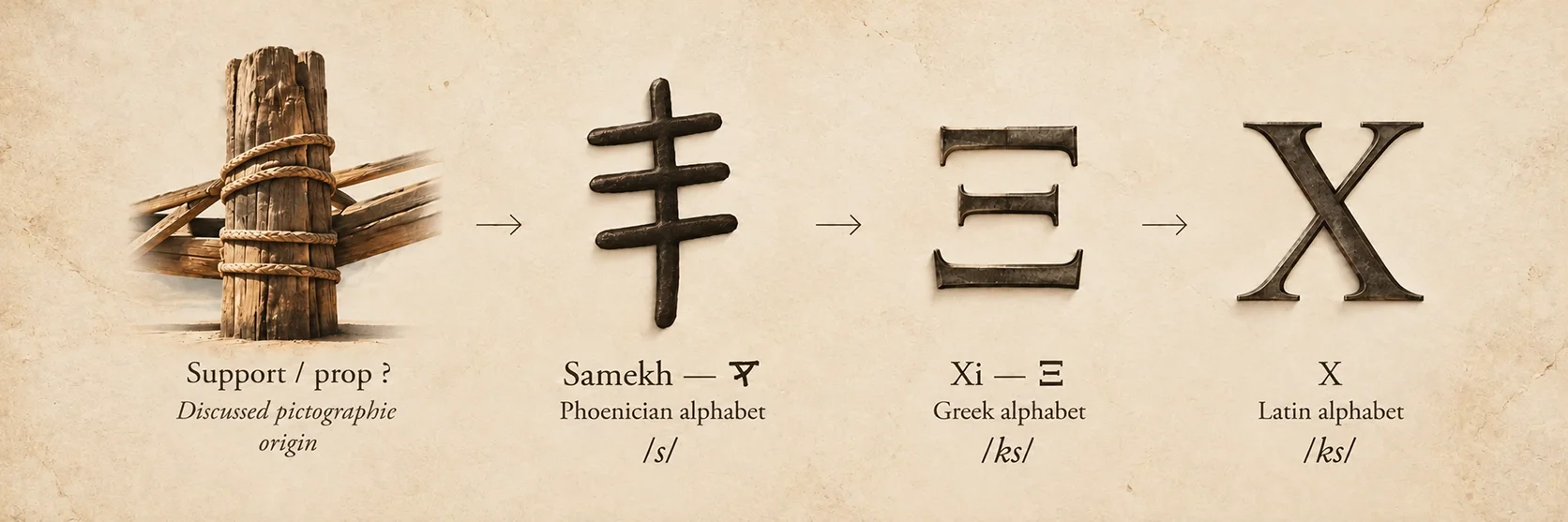
From Samekh to Xi
Its passage into the Greek world profoundly altered the function of the letter.
In several archaic Greek alphabets, the sign inherited from Samekh was used to represent the consonant cluster /ks/. It gradually became:
Xi — Ξ
Its phonetic value was therefore no longer the same as that of Phoenician Samekh.
This adaptation belongs to a particularly complex part of alphabetic history. Phoenician distinguished several sibilant consonants, while Greek organised these sounds differently. Greek writers did not simply assign an identical equivalent to every Phoenician sign.
They redistributed the signs available to them.
Samekh is one of the clearest examples of this process.
The situation also varied from one Greek region to another. Not all archaic Greek alphabets used Xi in the same way, and some did not use it for /ks/ at all.
The transmission was therefore not a single, uniform line across the Mediterranean.
Samekh at Byblos
At Byblos, Samekh is not simply a letter reconstructed from an alphabet chart.
It appears in ancient inscriptions from the city itself.
The sarcophagus of Ahiram, discovered in the royal necropolis of Byblos and now preserved at the National Museum of Beirut, bears one of the most important early Phoenician inscriptions known today. Palaeographic studies generally place it around the beginning of the first millennium BCE.
In the second part of the inscription, the letter Samekh appears notably in the word transliterated SKN, commonly translated as “governor”.
The passage refers to anyone who might come against Byblos and violate the tomb: a king among kings, a governor among governors, or a commander of an army.
Samekh thus belongs to a sentence actually carved at Byblos almost three thousand years ago.
This detail restores the letter to the context in which it matters most: not as part of a theoretical genealogy of signs, but as part of a language that was written and used.
A letter without a direct Latin heir
The fate of Samekh is unusual.
Its sign contributed to the development of Greek Xi — Ξ, but that letter was not adopted as such into the Latin alphabet.
Latin does of course have an X, also representing /ks/, but its graphic history follows a different route through western Greek alphabets and the Italic writing traditions.
It would therefore be misleading to reduce the history to:
Samekh → Xi → X
Samekh instead shows that alphabets are not transmitted through perfectly regular chains.
A shape can survive while its sound changes.
A letter can continue in one tradition and disappear in another.
And a relationship that appears obvious today may in fact conceal several different historical paths.
Sources and references
DEAPS — Digital Editions of Aramaic and Phoenician Sources, KAI 001, Ahiram inscription.
Digital scholarly edition of the Phoenician inscription, including transcription, translation, palaeographic dating and bibliography.
The Cambridge Ancient History, “Greek Alphabetic Writing”.
Reference study on the adaptation of the Semitic/Phoenician alphabet in the Greek world, including the evidence provided by letter order, names and shapes.
John K. Papadopoulos, “The Early History of the Greek Alphabet: New Evidence from Eretria and Methone”, Antiquity, vol. 90, 2016, pp. 1238–1254.
A modern archaeological and linguistic discussion of the emergence and regional development of early Greek alphabets.
Roger D. Woodard, “Vowel Representation in the Archaic Greek and Old Aramaic Scripts”, in Understanding Relations Between Scripts II: Early Alphabets.
Study of the adaptation of the Northwest Semitic writing system to Greek and the different phonological requirements of the two languages.
René Dussaud, “Les inscriptions phéniciennes du tombeau d’Ahiram, roi de Byblos”, Syria, vol. 5, 1924, pp. 135–157.
Primary scholarly study of the Ahiram inscriptions, Phoenician letter forms and early alphabetic development.
The Unicode Standard — Phoenician, U+10900–U+1091F.
Technical reference for the encoding of Samekh — 𐤎 as PHOENICIAN LETTER SEMK.