
Ayin — 𐤏
The sixteenth letter of the Phoenician alphabet.

Ayin holds a distinctive place in the history of the alphabet. In first-millennium BCE Phoenician, the letter Ayin (𐤏) represented a deep consonantal sound, usually transliterated as ʿ and traditionally reconstructed as a voiced pharyngeal consonant.
Greek had no direct equivalent for this sound.
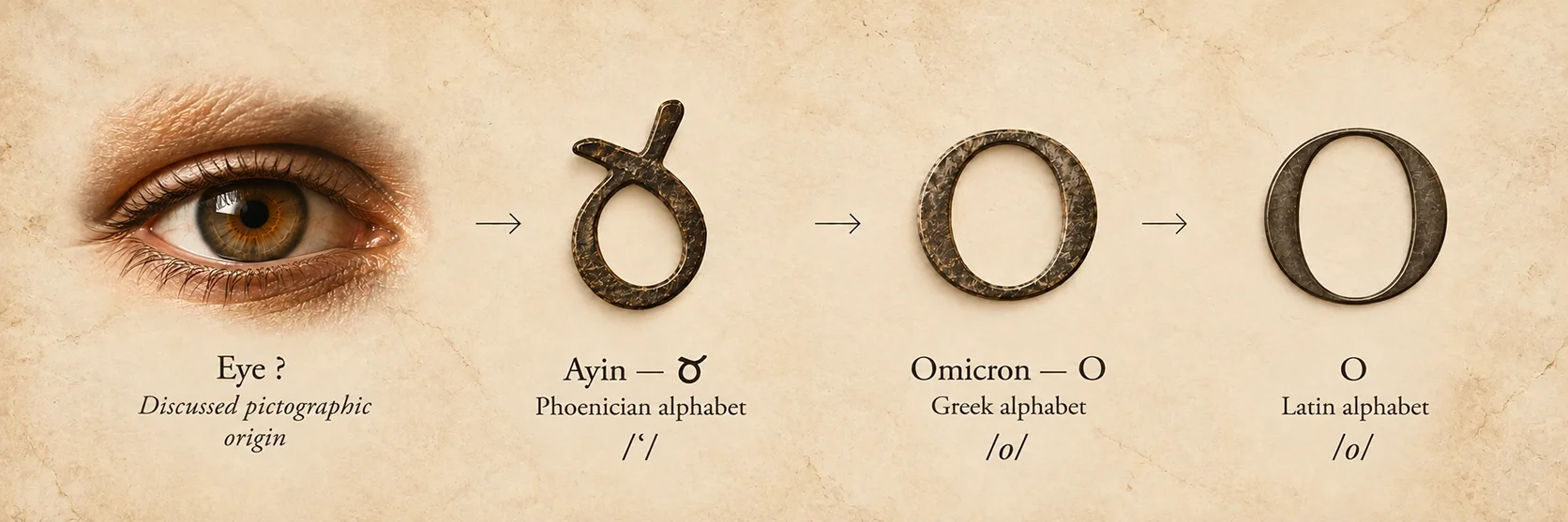
When the sign entered the Greek writing system, its function therefore changed completely: a consonant became a vowel. Ayin gave rise to the Greek O, later known as Omicron — Ο, and through it to the Latin O.
It is one of the clearest examples of functional transformation in the history of alphabetic writing.
An eye behind the sign
The pictographic origin of Ayin is considerably better documented than that of many other Phoenician letters.
The word ʿayin means “eye” in several Semitic languages. Early alphabetic forms support this connection: the sign often appears as a circle or oval, sometimes with a central dot suggesting a pupil.
A particularly early example, discovered at Tel Lachish and dated to the fifteenth century BCE, includes a circular Ayin that researchers explicitly relate to the Egyptian hieroglyph representing an eye.
As the sign evolved, the central pupil often disappeared.
What remained was an elementary geometric form:
a circle.
This simple shape probably contributed to the remarkable visual continuity between the ancient sign, the Greek O and the Latin O.
Unlike more speculative pictographic reconstructions, the connection between Ayin, the eye and the circular form is supported by a coherent combination of linguistic and palaeographic evidence.
When a consonant becomes a vowel
The most important transformation in Ayin’s history took place in the Greek world.
The pharyngeal sound represented by Phoenician Ayin had no equivalent in Greek. The inherited sign was therefore available for a new function.
Greek writers used it to represent the vowel sound /o/.
The change is striking:
Ayin — 𐤏: consonant
became
O — Ο: vowel
The transformation therefore involved more than the appearance of a letter. Its linguistic function changed as well.
Ayin belongs to a small group of Semitic signs that were reassigned to vowel sounds during the adaptation of the alphabet to Greek. In the case of Ayin, the result is especially clear: a sign that once represented a consonant articulated deep in the throat came to represent one of the simplest vowel sounds in Greek.
The name Omicron, literally “small o”, is later. It was used to distinguish this letter from Omega, the “large o”, which emerged during the subsequent development of the Greek alphabet.
Ayin and Byblos
The inscription of King Yehimilk, discovered at Byblos and generally dated to the tenth century BCE, provides a direct example of Ayin in the written language of the city.
The text invokes Baʿalshamem and Baʿalat Gebal — the Lady of Byblos.
In both names, the consonant transliterated as ʿ corresponds to Ayin.
The inscription asks Baʿalshamem, the Lady of Byblos and the assembly of the gods to prolong the days and years of King Yehimilk over Byblos.
The presence of Ayin in Baʿalat Gebal is especially significant in the context of the city: the letter appears within the title of Byblos’ principal protective goddess.
Here, Ayin does not belong to an abstract alphabet chart. It forms part of the religious and political vocabulary of ancient Byblos.
From an eye to the letter O
Few letters allow us to follow the transformation from image to abstract sign so clearly.
An eye.
Then a circle.
A Semitic consonant.
Then a Greek vowel.
And finally the O we still use today.
Ayin shows that the transmission of an alphabet is not simply a matter of copying shapes. When a writing system moves from one language to another, signs can be reassigned to meet entirely different linguistic needs.
In the case of Ayin, the shape has travelled across almost four millennia with remarkable stability.
Its sound did not.
Sources and references
Felix Höflmayer, Haggai Misgav, Lyndelle Webster & Katharina Streit, “Early alphabetic writing in the ancient Near East: the ‘missing link’ from Tel Lachish”, Antiquity, vol. 95, 2021, pp. 705–719.
Archaeological and palaeographic study of a fifteenth-century BCE inscription; the authors identify Ayin as a circular sign derived from the image of an eye.
DEAPS — Digital Editions of Aramaic and Phoenician Sources, KAI 004, Yehimilk inscription.
Digital scholarly edition of the Phoenician inscription from Byblos, including transcription and translation; Ayin appears notably in Baʿalshamem, Baʿalat Gebal and other words in the text.
James B. Pritchard (ed.), Ancient Near Eastern Texts Relating to the Old Testament, “Yehimilk of Byblos”.
Translation and commentary on the royal inscription of Yehimilk, usually dated to the tenth century BCE.
R. D. Woodard, “Greek Script”, International Encyclopedia of the Social & Behavioral Sciences.
Linguistic discussion of the Greek adaptation of Phoenician signs, including the reassignment of Ayin from a pharyngeal consonant to a vowel sign for /o/.
Gerald Leonard Cohen, “The Origin of the Letter Omicron”, Kadmos, vol. 21, 1982.
Study specifically devoted to the relationship between Phoenician Ayin and Greek O, and to the problems raised by this functional reassignment.
The Unicode Standard — Phoenician, U+10900–U+1091F.
Technical reference: Ayin — 𐤏 is encoded as U+1090F, PHOENICIAN LETTER AIN.