
Pe — 𐤐
The seventeenth letter of the Phoenician alphabet.

Pe is the seventeenth of the twenty-two letters of the Phoenician alphabet. The letter Pe (𐤐) represents the sound /p/, a consonant produced by closing and then releasing the lips.
Its history has one particularly striking feature: unlike Ayin, whose phonetic value changed radically when it entered Greek, Pe preserved its basic sound almost unchanged.
From Phoenician Pe to Greek Pi — Π, and later to the Latin P, the shape changed considerably.
The sound did not.
The mouth… probably
The name of the letter is traditionally connected with the Semitic word for “mouth”: pē or pe.
This interpretation fits the acrophonic principle used in the earliest alphabets: an object was named by a word whose initial sound provided the value of the letter. A “mouth” could therefore represent the sound /p/.
But the name of the letter must be distinguished from the precise origin of its graphic form.
The idea that the earliest sign directly represented a mouth is old and widely repeated. Yet the identification of the original pictogram remains debated.
A study of an early alphabetic inscription discovered at Tel Lachish shows that several models have been proposed for Pe. Some scholars relate its shape to an Egyptian hieroglyph representing an architectural corner or angle, while another interpretation sees it as a construction tool.
The mouth therefore remains the traditional explanation for the name and acrophonic logic of Pe.
The exact image behind its graphic form, however, cannot be stated with the same degree of certainty.
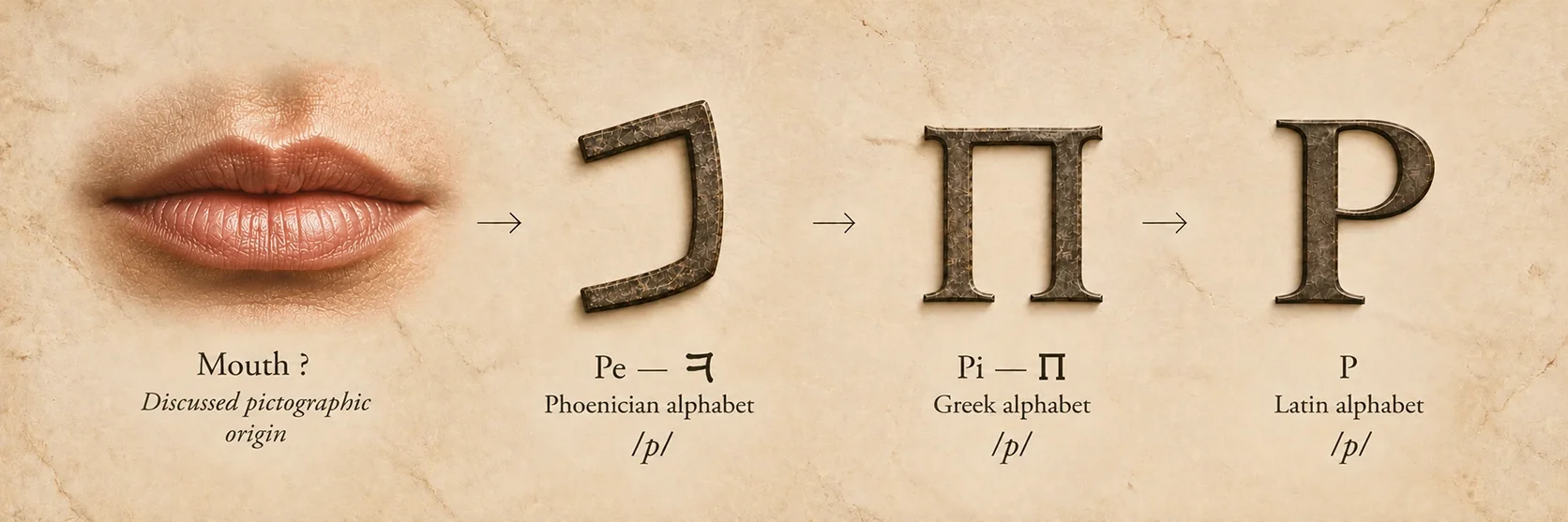
From Pe to Pi
When the Phoenician alphabet was adapted to Greek, Pe did not present the same problem as Ayin.
Greek had the sound /p/.
There was therefore no need to reassign the letter to a different phonetic function.
Pe became:
Pi — Π
and continued to represent /p/.
The main transformation was graphic.
The earliest Greek forms of Pi were not all identical to the symmetrical Π familiar today. Archaic Greek alphabets display several regional variants, some of which remain much closer to forms inherited from the Levant.
Over time, the Greek shape became increasingly regularised, eventually producing the classical form of Pi.
The stability of the sound therefore contrasts with the changing appearance of the sign.
From Pi to P
The story then continues westward.
Greek alphabets used across the Mediterranean were not graphically identical. Western forms of Pi were transmitted into the Italic writing traditions, including Etruscan, before entering the Latin alphabet.
It is this western branch that gradually leads to P.
The Latin P therefore does not immediately resemble classical Greek Π.
Yet both belong to the same historical lineage. The intermediate forms reveal the continuity.
Pe and Byblos
A royal inscription from Byblos provides a particularly interesting example of Pe.
It is engraved on a bust of the Egyptian pharaoh Osorkon, reused by the Byblian king Elibaal at the beginning of the first millennium BCE. The object is now preserved at the Louvre Museum.
The inscription begins with a verb transliterated PʿL, built on the Semitic root meaning “to make” or “to do”.
The first sign of this word is Pe.
The text states that Elibaal, king of Byblos, “made” — or possibly commissioned — the object before continuing with his royal titulature.
This Pe is therefore carved on an object that encapsulates the cultural connections of the city: an Egyptian royal sculpture carrying a Phoenician inscription commissioned or appropriated by a ruler of Byblos.
Here, the history of a letter intersects with the history of exchange between two worlds.
A changing shape, a lasting sound
Pe tells a story of remarkable phonetic continuity.
Its shape changes.
It shifts orientation, becomes more geometric, adopts different regional forms, and eventually produces two modern letters that no longer look immediately related:
Π and P.
Yet through all these transformations, its basic phonetic value remains largely unchanged.
The /p/ of Phoenician Pe is still the /p/ of Greek Pi and Latin P.
Among the twenty-two letters of the Phoenician alphabet, Pe therefore offers a particularly clear example of phonetic continuity beneath graphic transformation.
Sources and references
Felix Höflmayer, Haggai Misgav, Lyndelle Webster & Katharina Streit, “Early alphabetic writing in the ancient Near East: the ‘missing link’ from Tel Lachish”, Antiquity, vol. 95, 2021, pp. 705–719.
Important palaeographic study of early alphabetic forms. The authors discuss several competing hypotheses for the graphic origin of Pe and stress that the question remains open.
Madadh Richey, “The Alphabet and its Legacy”, in The Oxford Handbook of the Phoenician and Punic Mediterranean, Oxford University Press, 2019.
Recent overview of the Phoenician alphabetic tradition and its adaptation across the Mediterranean, including the Greek and Italic worlds.
John K. Papadopoulos, “The Early History of the Greek Alphabet: New Evidence from Eretria and Methone”, Antiquity, vol. 90, 2016, pp. 1238–1254.
Study of the earliest Greek alphabets, their regional variants and their circulation within Mediterranean networks.
DEAPS — Digital Editions of Aramaic and Phoenician Sources, KAI 006, Elibaal inscription.
Digital scholarly edition of the Phoenician inscription engraved on the Osorkon bust. The inscription is palaeographically dated to approximately 920–900 BCE and notably begins with the verb PʿL.
René Dussaud, “Dédicace d’une statue d’Osorkon I par Eliba’al, roi de Byblos”, Syria, vol. 6, 1925, pp. 101–117.
Publication and historical study of the Elibaal inscription and the Egyptian bust bearing the Phoenician text.
The Unicode Standard — Phoenician, U+10900–U+1091F.
Technical reference for the encoding of Pe — 𐤐 as PHOENICIAN LETTER PE.