
Tsade — 𐤑
The eighteenth letter of the Phoenician alphabet.

Tsade is probably one of the most difficult Phoenician letters to follow once it leaves the Semitic world.
In first-millennium BCE Phoenician, the letter Tsade (𐤑), traditionally transliterated ṣ, represented what is usually described as an emphatic consonant. Its exact pronunciation remains debated: modern reconstructions range from a strengthened sibilant to a sound closer to an emphatic affricate.
When the Phoenician writing system was adapted to Greek, this consonant had no obvious equivalent.
This is where the history of Tsade becomes particularly complex.
Unlike Pe or Ayin, there is no simple line leading from Tsade to a familiar modern letter.
An origin that remains obscure
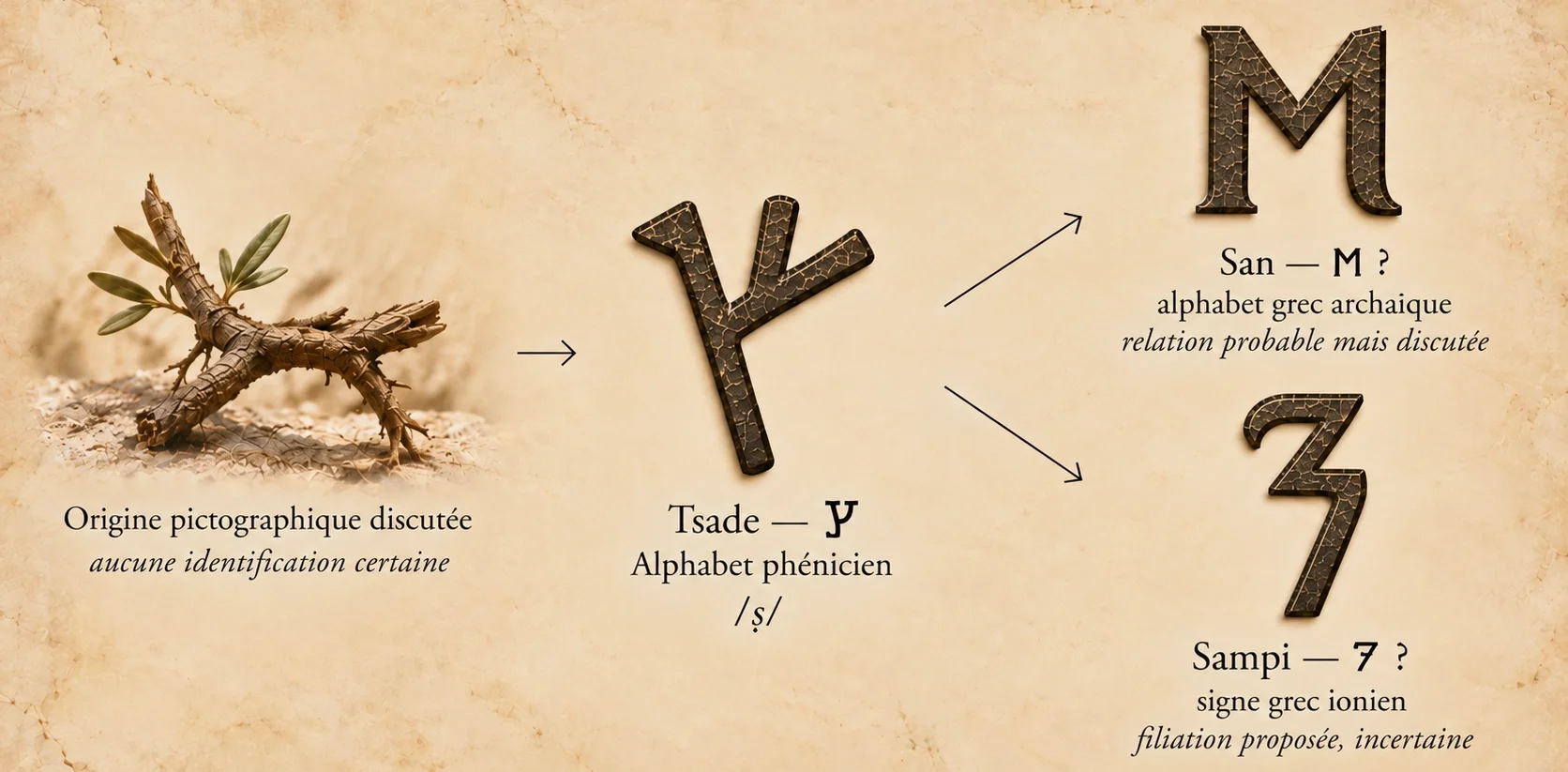
The pictographic origin of Tsade is uncertain.
Even the name of the letter does not offer the same clear point of reference as Ayin, “eye”, or Pe, traditionally associated with the “mouth”.
Many attempts have been made to identify an object or image behind the earliest form of Tsade. None has gained enough support to be presented as an established origin.
This uncertainty is not new.
Tsade has long been regarded as one of the more difficult problems in the genealogy of alphabetic signs, precisely because shapes, phonetic values and proposed correspondences do not always align satisfactorily.
For this letter, caution is therefore preferable to an attractive but fragile reconstruction.
A sound that was difficult to transmit
The problem becomes clearer when Tsade enters the Greek world.
Phoenician distinguished several sibilant consonants that Greek did not organise in the same way. Tsade represented one of these distinctive consonants, traditionally classified as emphatic.
Greek writers therefore had to decide what to do with a sign corresponding to a sound that did not fit naturally into their language.
The solutions were not uniform.
Some archaic Greek alphabets used a letter known as San — Ϻ, employed for a sibilant and often associated with Phoenician Tsade. Other traditions used Sigma.
But even this correspondence is not entirely secure: the relationships between Tsade, San, Sigma and the various Greek sibilants have been extensively debated.
It would therefore be misleading to write simply:
Tsade → San
as though the relationship were as certain as Pe → Pi.
And Sampi?
The story becomes even more intriguing with another Greek character.
In some inscriptions from Asia Minor, particularly in Ionian regions, a special sign appears for a distinctive consonant or consonant cluster. This character is often regarded as an ancestor of the later Greek numerical sign known as Sampi — ϡ.
Some scholars have proposed a connection between this sign and Semitic Tsade.
The functional similarity is interesting: in both cases, the sign appears to represent an unusual consonant, probably somewhere between a sibilant and an affricate.
But once again, the lineage is not universally accepted.
Studies of Greek epigraphy generally present the derivation from Tsade as possible rather than certain, and alternative explanations for the origin of Sampi have also been proposed.
Tsade therefore does not produce a single straightforward branch.
Instead, it sits at the centre of a network of possible correspondences.
Tsade and Byblos
The royal inscription of Yehimilk, discovered at Byblos and palaeographically dated to approximately 950–920 BCE, provides a particularly revealing example of Tsade.
Near the end of the text appears the word transliterated:
ṢDQ
Its first sign is Tsade.
The term belongs to a Semitic root associated with justice, legitimacy and righteousness.
In the inscription, Yehimilk is presented as a “legitimate and righteous” king before the holy gods of Byblos.
Tsade therefore appears at the heart of an explicit claim to royal legitimacy.
The importance of this example goes beyond simply identifying the shape of a letter: it shows writing being used as part of the construction of political authority.
The king restores temples.
He invokes Baalshamem, Baʿalat Gebal and the gods of the city.
Then the inscription asserts his legitimacy.
The letter Tsade (𐤑) is therefore directly embedded in the political and religious vocabulary of Byblos at the beginning of the first millennium BCE.
A letter without a straight line
Tsade is compelling precisely because its history resists simplification.
Its visual origin is uncertain.
Its exact ancient pronunciation cannot be reconstructed with complete confidence.
Its adaptation into Greek varies from one region to another.
And its possible relationships with San and Sampi still require careful qualification.
Tsade therefore reminds us of something essential: the history of the alphabet is not a perfectly ordered sequence of characters passed unchanged from one people to another.
Some signs cross the centuries with relatively little disruption.
Others change sound or function.
And some, like Tsade, divide into paths that do not all lead directly to the alphabets we use today.
Sources and references
Holger Gzella, “Phoenician”, in The Semitic Languages: An International Handbook, 2011.
Linguistic reference on Phoenician phonology. Gzella classifies Tsade among the emphatic consonants and notes that their exact phonetic realisation remains debated.
Françoise Briquel Chatonnet & Robert Hawley, “Phoenician and Punic”.
Linguistic overview proposing, among possible reconstructions of the Phoenician consonant system, an emphatic affricate realisation for ṣ.
Oxford Classical Dictionary, “alphabet, Greek”.
Overview of the Greek adaptation of the Semitic model and of the regional coexistence of different solutions for the sibilants, including San and Sigma.
F. W. G. Foat, “Tsade and Sampi”, The Journal of Hellenic Studies, vol. 25, 1905, pp. 338–365.
Classic study devoted specifically to the problematic relationships between Tsade, San and Sampi, illustrating the long history and complexity of the debate.
DEAPS — Digital Editions of Aramaic and Phoenician Sources, KAI 004, Yehimilk inscription.
Scholarly edition of the royal inscription from Byblos, dated to approximately 950–920 BCE. The word ṢDQ appears in the formula describing Yehimilk as a legitimate and righteous king.
The Unicode Standard — Phoenician, U+10900–U+1091F.
Technical reference: Tsade — 𐤑 corresponds to U+10911, PHOENICIAN LETTER SADE.