
Qoph — 𐤒
The nineteenth letter of the Phoenician alphabet.

Qoph occupies a distinctive place in the history of the alphabet.
In first-millennium BCE Phoenician, the letter Qoph (𐤒), transliterated q, represented a consonant distinct from Kaph. It belonged to the group traditionally described as emphatic consonants and was probably articulated further back in the mouth than /k/, although its exact ancient pronunciation remains debated.
When Greek speakers adopted the sign, this distinction no longer corresponded to a useful contrast in their language.
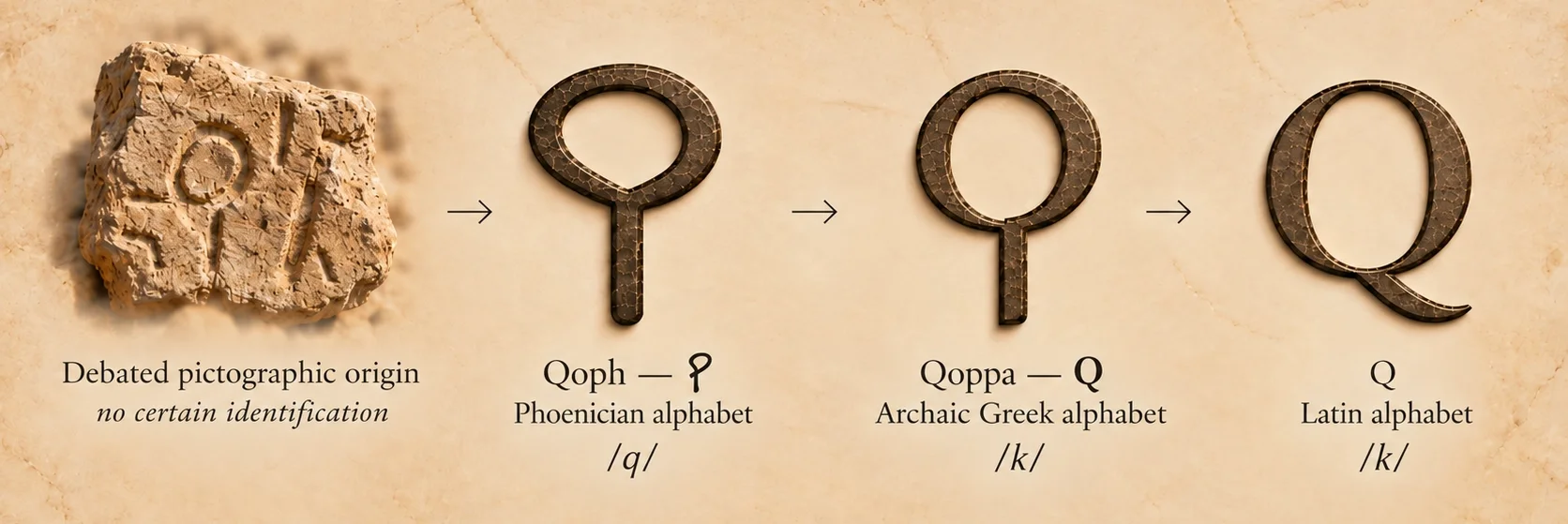
Qoph became Qoppa — Ϙ.
But unlike Kappa, Qoppa eventually disappeared from the ordinary Greek alphabet.
Its story, however, did not end there.
An uncertain pictographic origin
The origin of both the name Qoph and its earliest graphic form remains difficult to establish.
Several interpretations have been proposed over time, but none is as securely supported as the connection between Ayin and the eye, for example.
This difficulty has long been recognised. In his classic study of writing systems, Ignace J. Gelb lists qōph among the Semitic letter names that can be related to known words, while noting how difficult it is to connect some of these names convincingly with a specific original image.
It would therefore be unwise to present any one proposal — a neck, head, opening or other object — as established fact.
For Qoph, the historical letter forms are better documented than the pictogram that may have preceded them.
Qoph and Kaph: a distinction Greek no longer needed
Phoenician distinguished between two consonants:
Kaph — /k/
and
Qoph — /q/.
This contrast mattered in the language.
In Greek, it largely lost its phonemic purpose.
The earliest Greek alphabets nevertheless retained both signs. Qoph became Qoppa — Ϙ and was used in some traditions, particularly in certain phonetic environments involving back or rounded vowels, while Kappa appeared elsewhere.
The two signs were therefore no longer representing two clearly distinct phonemes.
Qoppa increasingly functioned as a graphic alternative to Kappa.
Eventually, Kappa was enough.
Qoppa disappeared from ordinary alphabetic use.
It nevertheless acquired another life within the Greek numeral system, where the sign associated with Qoppa came to represent the number 90.
A Greek letter disappears, but Q survives
While Qoppa gradually faded from everyday Greek writing, another branch of its history developed further west.
The Etruscans adopted a number of signs from western Greek alphabets, including the ancestors of C, K and Q.
In early Italic writing traditions, all three characters could represent sounds close to /k/, with their use partly determined by the vowel that followed.
Latin inherited this system.
Over time, C became the principal letter for /k/, while Q became increasingly specialised before U.
This history lies behind the combination QU, still visible in French words such as qui, quatre and question, as well as in many other languages using the Latin alphabet.
Thus, a letter that disappeared from ordinary Greek writing left behind a descendant that remains fully alive:
Q.
Qoph at Byblos
At Byblos, Qoph appears in an inscription whose archaeological context is particularly revealing.
The inscription of King Shipitbaal, palaeographically dated to approximately 900–880 BCE, was discovered in 1945 near a wall on the acropolis, within the sanctuary area.
The text begins with the word:
QR
translated as “wall”.
Its first sign is Qoph.
Shipitbaal states that he built or rebuilt this wall for Baʿalat Gebal, the Lady of Byblos, before asking the goddess to prolong his days and years over the city.
The inscribed block itself appears to have belonged to the upper section of a retaining wall associated with a well.
The relationship between word and object is therefore almost physical:
the letter Qoph (𐤒) begins the word for “wall” on a stone that probably formed part of that very architectural structure.
Here, writing does not merely describe a construction.
It was part of it.
The letter that survived elsewhere
Qoph follows a different path from the letters we have encountered so far.
Greek adopts the sign but no longer truly needs the phonetic distinction it once represented.
The letter becomes Qoppa.
Then it disappears from ordinary Greek alphabetic use.
Its history might appear to end there.
Yet through western Greek alphabets, and later through Etruscan and Latin writing, its form continues along another route.
Our modern Q is the result of that western branch.
Qoph therefore shows how a letter can disappear in one tradition while surviving for centuries in another.
Sources and references
Holger Gzella, “Phoenician”, in The Semitic Languages: An International Handbook, 2011.
Reference study of Phoenician phonology. Qoph belongs to the group traditionally classified as emphatic consonants, whose exact phonetic realisation remains debated.
Ignace J. Gelb, A Study of Writing, University of Chicago Press, 1952; revised edition, 1963.
A foundational study of writing systems. Gelb discusses the difficulty of connecting certain Semitic letter names, including Qoph, with a specific original pictographic image.
E. H. Sturtevant, “The Pronunciation of Latin qu and gu”, Language, vol. 15, pp. 221–223.
Study of the transmission of Qoph into Greek Qoppa and of the respective use of Qoppa and Kappa in early Greek and later Etruscan writing.
Nicholas Zair, Orthographic Traditions and the Sub-elite in the Roman Empire, Cambridge University Press, 2023, chapter 12.
Recent analysis of the Latin inheritance of C, K and Q from Etruscan practice and of the gradual specialisation of Q before U.
DEAPS — Digital Editions of Aramaic and Phoenician Sources, KAI 007, Shipitbaal inscription.
Scholarly edition of the royal inscription from Byblos, dated to approximately 900–880 BCE. The text begins with QR, “wall”, and records Shipitbaal's construction for Baʿalat Gebal.
The Unicode Standard — Phoenician, U+10900–U+1091F.
Technical reference for Phoenician writing and its right-to-left behaviour; Qoph belongs to the encoded series of twenty-two Phoenician consonantal letters.