
Resh — 𐤓
The twentieth letter of the Phoenician alphabet.

Resh is the twentieth of the twenty-two letters of the Phoenician alphabet. The letter Resh (𐤓) represents a rhotic consonant, usually transliterated r.
Its history is one of the most continuous in the alphabet.
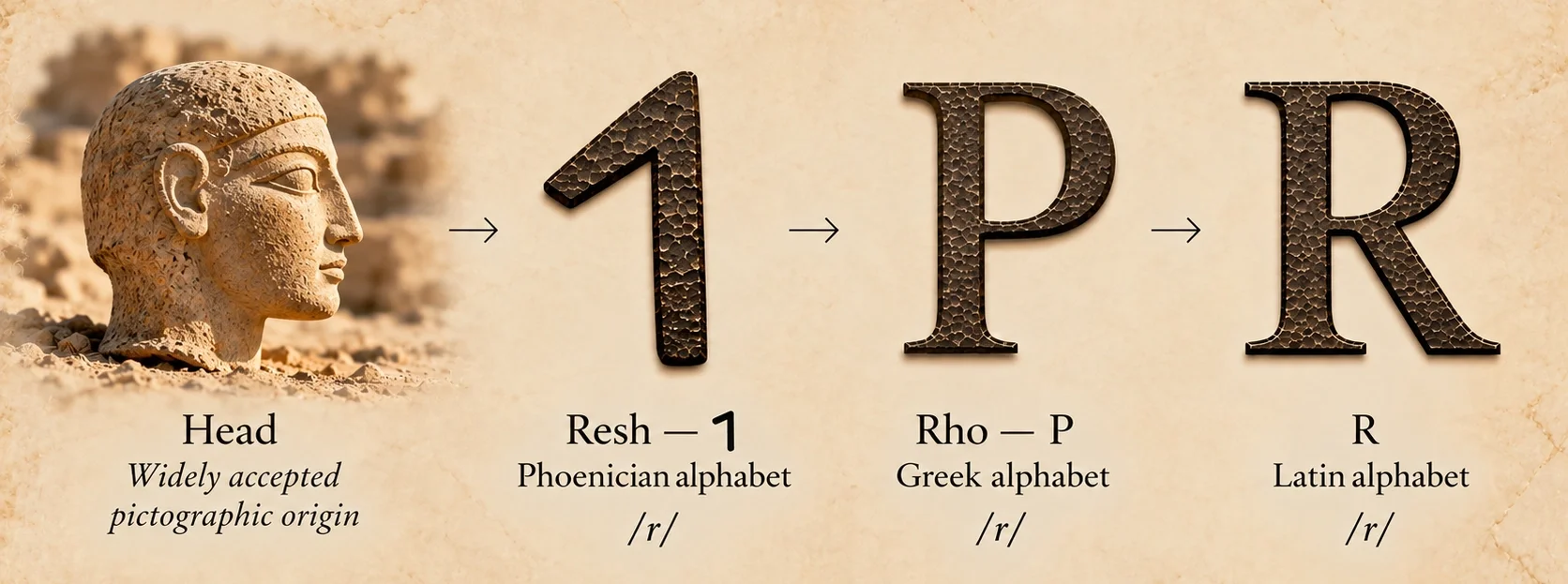
The name is traditionally connected with the Semitic word for “head”. The sign passes into Greek as Rho — Ρ, then continues through western Greek and Italic traditions toward the Latin R.
The sound remains recognisable.
The shape changes more dramatically.
A head behind the letter
Among the pictographic origins proposed for Phoenician letters, that of Resh is one of the more convincing.
The name is linked to a Northwest Semitic word meaning “head”, related for example to Hebrew rosh. Early alphabetic traditions also preserve signs that have been interpreted as simplified representations of a human head.
The principle is acrophonic: the image of a head, named by a word beginning with /r/, provides the value of the letter.
The Penn Museum specifically uses Resh as an example of this mechanism in the earliest alphabetic systems: a human head could supply the sound /r/ because the Semitic word for “head” began with that consonant.
A degree of caution is still necessary.
The relationship between the name, the head and the sound /r/ is well supported. Reconstructing every graphic stage between a very early figurative sign and historical Phoenician Resh remains a matter of palaeographic interpretation.
From Resh to Rho
When Greek speakers adapted the Phoenician alphabet, they preserved both the general position of the sign and its consonantal value.
Resh became:
Rho — Ρ
and continued to represent an /r/-type sound.
This is therefore a very different transmission from that of Ayin or Qoph: there was no need to assign the sign a new phonetic function.
Yet the relationship may look surprising to a modern reader.
The Greek capital Ρ resembles our P, even though it is pronounced like R.
What now seems visually obvious to us — associating the shape R with the sound /r/ — is actually the result of a later graphic development.
When R separates from P
The Latin alphabet did not emerge directly from Phoenician.
It inherited a western Greek tradition, transmitted and reshaped through the Etruscans.
Within this transmission, the forms related to Rho continued to evolve.
A graphic problem gradually emerged: a form close to P could represent /r/, while another sign was required for /p/.
In the Latin tradition, Resh/Rho eventually acquired the descending diagonal stroke that produced:
R
The visual distinction between P and R, which now seems elementary, is therefore the result of a gradual differentiation.
This is the point at which the ancient profile of Resh becomes recognisably our modern letter.
Resh and Byblos
An inscription of King Abibaal provides Resh with a particularly evocative context.
Palaeographically dated to approximately 940–930 BCE, it is engraved on the base of a statue bearing the cartouches of the Egyptian pharaoh Sheshonq I. The monument is now preserved in Berlin.
Within the Phoenician text appears the word:
MṢRM
translated in this context as “Egypt”.
Resh is its penultimate consonant.
The inscription states that Abibaal, king of Byblos, had the statue brought from — or, according to some interpretations, made in — Egypt for Baʿalat Gebal, the Lady of Byblos. The text is partially damaged, so its reconstruction requires caution, but the reading of MṢRM as “Egypt” fits the Egyptian nature of the monument itself.
The association is especially striking:
Resh appears in the word for Egypt, written in Phoenician on an Egyptian royal monument dedicated by a king of Byblos.
The letter becomes a material witness to the long relationship between the city and the Nile Valley.
From a head to R
Resh allows us to follow almost the entire history of a letter without a major break.
A head gives the sign its name.
The sign becomes Resh.
Resh becomes Rho.
Then a gradual graphic transformation distinguishes the Latin R from P.
At the end of this journey, the sound remains strikingly close to the one it represented in Phoenician.
The continuity is not only visual or linguistic.
It shows how a graphic convention created several millennia ago can be transformed and adapted while remaining recognisable to the present day.
Sources and references
Penn Museum, “The Alphabet”, Expedition Magazine.
Overview of the acrophonic principle in early alphabets and of the connection between the human head, the Semitic term raʾsh and the value /r/.
Joseph Naveh, “Resh”, Encyclopaedia Judaica.
Overview of the development of the sign from Proto-Canaanite forms to Greek Rho and later alphabetic traditions.
B. S. J. Isserlin, “Greek Alphabetic Writing”, The Cambridge Ancient History.
Reference study on the Greek adaptation of the Semitic alphabet and on the correspondences of order, name and form between the two traditions.
Bernhard Bischoff, Latin Palaeography: Antiquity and the Middle Ages.
Reference work on the origins of Latin script from a western Greek writing tradition transmitted and modified through the Etruscans.
DEAPS — Digital Editions of Aramaic and Phoenician Sources, KAI 005, Abibaal inscription.
Scholarly edition of the Phoenician inscription carried by the statue of Sheshonq I, including the word MṢRM, “Egypt”, and a palaeographic dating to approximately 940–930 BCE.
André Lemaire, “La datation des rois de Byblos Abibaal et Élibaal et les relations entre l’Égypte et le Levant au Xe siècle av. notre ère”, Comptes rendus de l’Académie des Inscriptions et Belles-Lettres, 2006.
Reassessment of the Abibaal inscription, its reading and the historical context of relations between Byblos and Egypt.