
Shin — 𐤔
The twenty-first letter of the Phoenician alphabet.

Shin is the penultimate letter of the Phoenician alphabet. The letter Shin (𐤔), traditionally transliterated š, represented a sibilant consonant generally reconstructed as a sound close to “sh”. The exact phonetic value of the ancient Semitic sibilants, however, remains a matter of linguistic debate.
Its history leads toward one of the most familiar letters in modern alphabets.
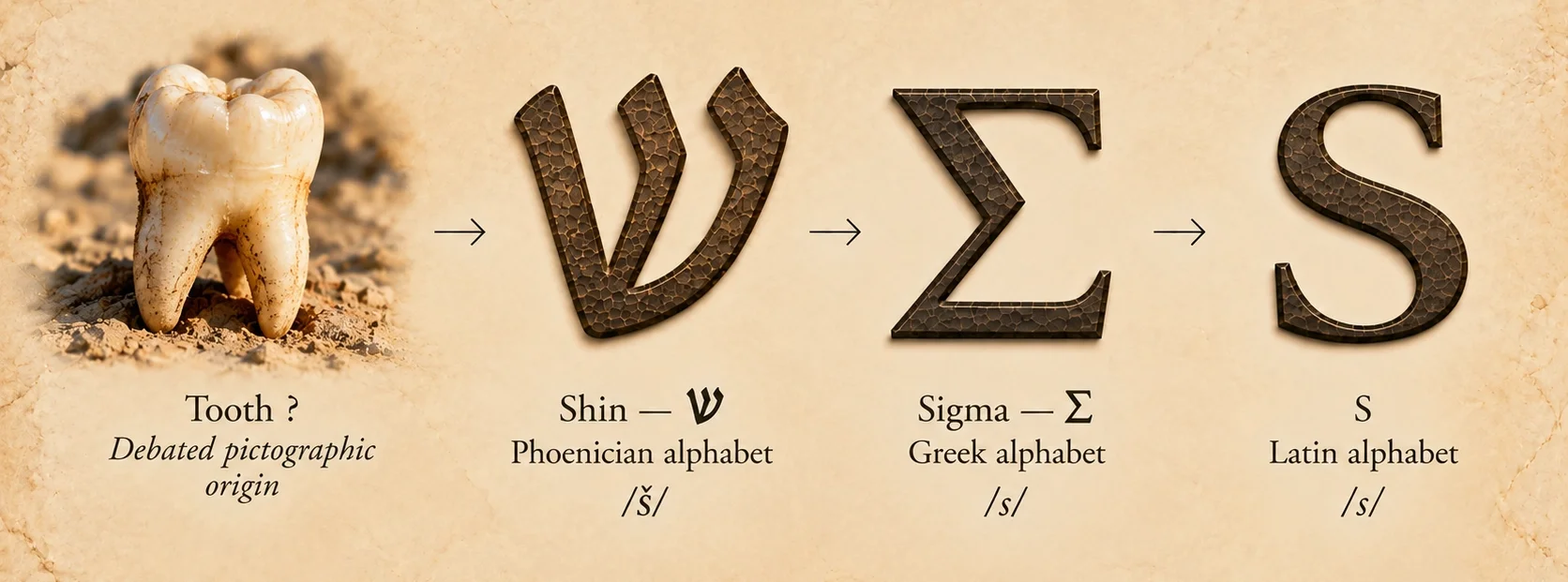
The form of Shin was adopted in the Greek world and developed into Sigma — Σ. Through western Greek and Italic traditions, this same lineage eventually produced the Latin S.
But behind this apparently simple story lies one of the more complex episodes in the adaptation of Phoenician writing to Greek.
A tooth behind the name
The name Shin belongs to an ancient Semitic family of words meaning “tooth”. Proto-Semitic šinn- is reconstructed with this meaning and has numerous descendants across Semitic languages.
The traditional interpretation therefore sees the earliest form of the letter as a stylised representation of a tooth, or possibly a row of teeth.
This identification, however, is less certain than simplified alphabet histories sometimes suggest.
Scholars have not always agreed on the original image. In his studies of Proto-Sinaitic inscriptions, William F. Albright also associated one early sign corresponding to Shin with a composite bow.
Two levels therefore need to be distinguished:
the connection between the name Shin and the word “tooth” is linguistically strong;
the precise reconstruction of the original pictogram remains more debated.
From Shin to Sigma
When Greek alphabets developed, they had to adapt a writing system that distinguished more sibilant consonants than Greek did.
For Shin, the graphic relationship with Sigma — Σ is particularly important.
Recent work on archaic Greek alphabets considers the zigzag forms of Sigma to derive from Semitic Shin. Alphabetic order supports this relationship as well: Shin and Sigma occupy corresponding positions after Resh/Rho.
But the transmission was not simply:
one sign + one sound + one name.
Greek essentially had one main sibilant /s/, whereas Phoenician distinguished several. Different Greek communities therefore selected and reorganised the available signs in different ways. Some used Sigma; others preferred San for /s/.
The history of Shin therefore reveals an important distinction:
the form of Sigma can be linked to Shin with considerable confidence, while the history of the names and phonetic values of the Greek sibilants is far more complex.
From Sigma to S
Archaic Sigma did not immediately have the regular form familiar today.
Greek inscriptions preserve a wide range of zigzag shapes, made with three, four or sometimes more strokes. Their orientation could also vary.
Some of these western Greek forms were transmitted to the Etruscans.
From the eighth century BCE onwards, Etruria adopted an alphabet derived from western Greek traditions. Italic writing systems, including Latin, subsequently developed from these Etruscan models.
The shape gradually became simpler.
The angular zigzag eventually evolved into the familiar curve:
S
Shin at Byblos
For Shin, a much later inscription allows us to broaden the chronological perspective on writing at Byblos.
The Yehawmilk Stele, dated to around 450 BCE, was discovered at Byblos. Its main section is now preserved at the Louvre Museum, while a fragment belongs to the National Museum of Beirut. The stele depicts King Yehawmilk making an offering to Baʿalat Gebal, the Lady of Byblos, and carries a long Phoenician inscription.
Several times, the text contains the formula:
WŠMʿ QL
“and she heard my voice”.
In the word ŠMʿ, Shin is the first lexical consonant.
Yehawmilk recounts that he called upon the Lady of Byblos, that she heard his voice, and that he then raised a bronze altar and carried out several works in her sanctuary. The same formula appears again later in the inscription.
This example is interesting for another reason.
Most of the royal inscriptions encountered in the previous letter profiles date from the beginning of the first millennium BCE. The Yehawmilk Stele belongs instead to the Achaemenid period, several centuries later.
Shin therefore also allows us to see the long continuity of Phoenician writing at Byblos.
From “sh” to our S
Shin presents an interesting paradox.
The shape survived.
The sound changed.
The Phoenician sign represented a consonant traditionally compared to “sh”. The Greeks adopted its form for their /s/. The letter became Sigma and then continued westward toward the Latin S.
At the scale of this single letter, we can therefore see what alphabetic transmission really means:
preserving a shape does not necessarily mean preserving exactly the same sound.
Behind the modern S still lies, transformed through centuries of Mediterranean writing, the ancient profile of Shin.
Sources and references
Holger Gzella, “Phoenician”, in The Semitic Languages: An International Handbook, 2011.
Reference study of the Phoenician consonantal system and of the value of Shin, while also stressing the difficulty of reconstructing ancient phonetic values with complete precision.
Natalia Elvira Astoreca, Early Greek Alphabetic Writing: A Linguistic Approach, Oxbow Books, 2021.
Recent study of archaic Greek alphabets. It examines Sigma, San and the problems involved in the transmission of Semitic sibilants; the form of Sigma is linked to Shin.
William F. Albright, The Proto-Sinaitic Inscriptions and Their Decipherment, Harvard University Press, 1966.
Classic study of early alphabetic writing, useful in showing that the pictographic reconstruction of Shin has not always been limited to the tooth hypothesis.
Oxford Classical Dictionary, “epigraphy, Etruscan”.
Overview of the adoption of western Greek alphabets in Etruria and their role in the formation of Italic writing traditions, including Latin.
Louvre Museum, “Yehawmilk Stele”, AO 22368, KAI 10.
Institutional record for the royal stele discovered at Byblos and dated to around 450 BCE.
Cahiers du Centre d’Études Chypriotes, study of prayer and hearing formulas in Phoenician inscriptions.
The study cites and translates passages from the Yehawmilk Stele containing WŠMʿ QL, “she heard my voice”.
The Unicode Standard — Phoenician, U+10900–U+1091F.
Technical reference: Shin — 𐤔 corresponds to U+10914, PHOENICIAN LETTER SHIN.