
Taw — 𐤕
The twenty-second and final letter of the Phoenician alphabet.

Taw closes the Phoenician alphabet.
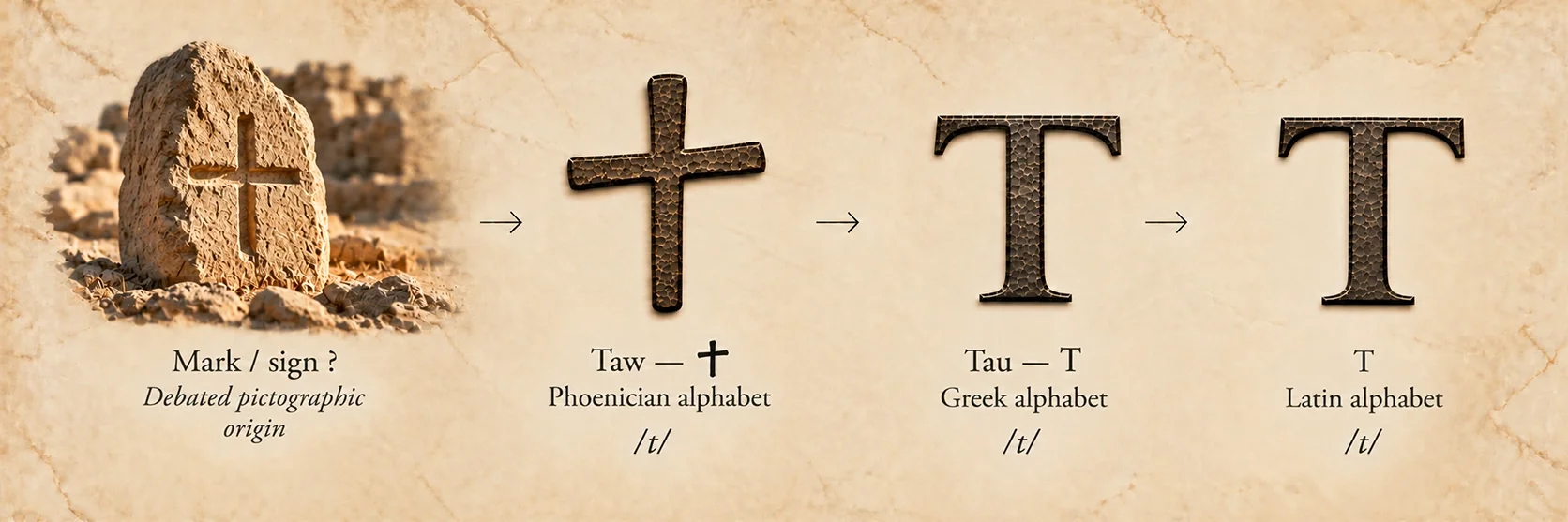
The letter Taw (𐤕), transliterated t, represented the consonant /t/. Of all the letters we have followed, its history is one of the most stable: its phonetic value was preserved when it became Tau — Τ in Greek, and later T in the Latin alphabet.
But its position matters just as much as its descendants.
In the Phoenician sequence, Shin is followed by Taw.
And there, the alphabet ends.
When the Greeks adopted this order, Tau retained its place at the end of the sequence inherited from Phoenician. The Greek letters that came after it would extend the alphabet beyond this older boundary.
A mark before it was a letter
The name Taw is traditionally connected with a Semitic word meaning “mark” or “sign.”
This etymology corresponds strikingly with the early forms of the character.
In Proto-Canaanite and early alphabetic traditions, Taw could take the form of two crossing strokes:
× or +
In other words, one of the simplest marks that can be drawn.
Joseph Naveh notes that early forms include both diagonal and upright crosses and connects this graphic simplicity directly with the meaning of the letter name: a mark.
From around the ninth century BCE onwards, its forms became increasingly regular within different writing traditions.
The precise derivation of the sign from a specific Egyptian image is harder to establish with certainty.
It is therefore safer to retain what the evidence supports most clearly:
the name evokes a mark, and the early alphabetic forms are indeed composed of two crossing strokes.
The letter that ended the alphabet
Taw has a feature no earlier letter shares:
it marks the end of the Phoenician alphabetic sequence.
The order and names transmitted into Greek preserve this Semitic inheritance:
Resh becomes Rho.
Shin corresponds to Sigma.
Taw becomes Tau.
Then the Phoenician sequence is complete.
Stephen Colvin notes that the Phoenician alphabet ended precisely with /t/, Taw, while the characters placed after Tau in Greek represent additions to the inherited sequence.
This distinction matters.
Tau is only the nineteenth letter of the modern Greek alphabet.
Historically, however, it still marks the point at which the alphabetic order received from Phoenician once ended.
Taw therefore preserves, within the order of the letters themselves, the memory of an earlier alphabet.
From Taw to Tau
Unlike Ayin, Qoph or Shin, Taw required almost no phonetic reinterpretation.
Greek already had a /t/ sound.
The sign could therefore retain its function:
Taw — /t/
became
Tau — Τ — /t/.
Its graphic development was also relatively straightforward.
The old cross-like sign became more regular. In Greek traditions, one stroke became horizontal while the other descended vertically from its centre.
The form Τ emerged.
Through western Greek and later Italic traditions, it was transmitted into Latin.
It became:
T
Few letters show such continuity between ancient sound, graphic structure and modern form.
Taw at Byblos
At Byblos, Taw appears in a context very different from the monumental royal inscriptions encountered in several of the previous letter profiles.
Inside the shaft leading to the tomb where the sarcophagus of Ahiram was discovered, at a depth of roughly three metres, a short inscription had been carved directly into the wall.
On palaeographic grounds, it belongs to the same broad period as Ahiram’s burial, around the beginning of the first millennium BCE.
The text begins with the word transliterated:
LDʿT
whose final consonant is Taw.
Literally related to the verb “to know,” the expression functions here as a warning:
“Beware!” / “Know this!”
The following words threaten misfortune upon anyone who ventures beneath that point and disturbs the tomb.
For the final letter of the alphabet, the example is almost uncannily appropriate.
Taw — whose name is associated with the idea of a mark — appears here within an actual mark carved into stone.
Not a long royal proclamation.
Only a few words.
A warning left in the darkness of a Byblos tomb almost three thousand years ago.
Where the alphabet ends
Taw completes the twenty-two letters.
Its history, however, does not end with them.
The mark becomes a letter.
The letter passes into Greek.
Tau preserves its sound.
Then the sign continues into the Latin T.
Meanwhile, the Greeks extend the sequence beyond Tau and gradually develop an alphabet of their own.
Taw therefore represents a very particular boundary:
the end of one alphabet becomes the starting point of another history.
Sources and references
Joseph Naveh, “Tav”, Encyclopaedia Judaica.
Palaeographic overview of Taw: the meaning of the name as “mark”, its early upright and diagonal cross forms, and its later graphic development.
Stephen Colvin, A Historical Greek Reader: Mycenaean to the Koiné, Oxford University Press, 2007.
Colvin notes that the Phoenician model ended with Taw /t/, corresponding to Tau, and that the Greek letters placed after Tau represent later extensions of the inherited sequence.
B. S. J. Isserlin, “Greek Alphabetic Writing”, The Cambridge Ancient History.
Reference study on the Greek adoption of Semitic letter names, order and forms.
Roger D. Woodard (ed.), The Ancient Languages of Europe, Cambridge University Press, 2008.
Reference work on ancient European languages and scripts, including the context of early Greek alphabetic traditions.
DEAPS — Digital Editions of Aramaic and Phoenician Sources, KAI 002, graffito from the Tomb of Ahiram.
Scholarly edition of the short inscription carved into the wall of the burial shaft at Byblos. Its opening word, LDʿT, ends with Taw and is interpreted as a warning.
The Unicode Standard — Phoenician, U+10900–U+1091F.
Technical reference: Taw — 𐤕 corresponds to U+10915, PHOENICIAN LETTER TAU.