
Nun — 𐤍
Fourteenth letter of the Phoenician alphabet.

Before N, there was Nun.
Nun is the fourteenth of the twenty-two letters of the Phoenician alphabet. In this consonantal writing system, it represents the sound /n/.
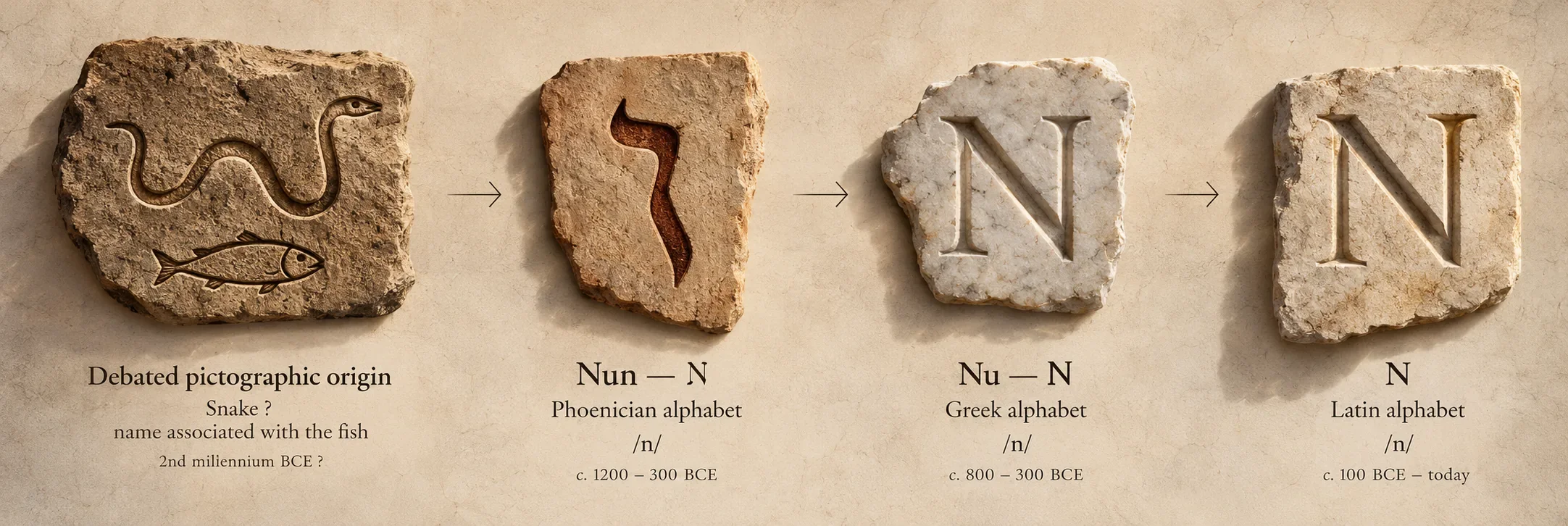
Its early history raises an interesting distinction: the traditional name of the letter and the proposed graphic prototype do not necessarily refer to the same thing.
The name Nun is traditionally associated with the fish. Yet one influential reconstruction of the Proto-Sinaitic signs connects the graphic ancestor of the letter with Egyptian hieroglyphs representing snakes.
Nun therefore reminds us that the name of a letter should not automatically be treated as a description of the image from which its sign developed.
Its later history is much clearer. Nun — 𐤍 became the Greek Nu — Ν, and eventually contributed directly to the Latin N.
Between snake and fish
The earliest alphabets used signs whose shapes often derived from objects in the visible world.
With Nun, however, identifying that original image requires some caution.
In her study of the Proto-Sinaitic corpus, Egyptologist Orly Goldwasser connects the sign representing /n/ with Egyptian hieroglyphs depicting snakes, forms that were common in inscriptions from Sinai. These signs had different values in Egyptian, but may have been reinterpreted by Semitic-speaking users to represent the sound /n/.
At the same time, the traditional name of the letter is Nun, commonly associated with the fish.
The two should not be confused.
It would therefore be too categorical to describe Nun simply as the stylisation of a fish.
The name Nun is associated with the fish, while an influential reconstruction of its pictographic ancestor points instead to the snake.
What is much better established is its alphabetic function: Nun — 𐤍 occupies the fourteenth position of the Phoenician alphabet and represents the consonant /n/.
By this stage, the sign had become an alphabetic character, and its phonetic function is far more secure than the precise history of the image behind it.
From Nun to Nu, then N
When the Greeks adapted the Phoenician alphabet to their own language, they also adopted Nun.
The letter became:
Nu — Ν
It retained the consonantal value /n/.
Its position in the alphabet changed, however. Nun is the fourteenth letter of the Phoenician sequence, while Nu occupies the thirteenth position in the modern Greek alphabet, following changes within the Greek alphabetic order over time.
The letter was then transmitted through the alphabets of ancient Italy and into Latin.
Its shape changed, but its consonantal function remained remarkably stable.
The sequence can therefore be summarised as:
Nun — 𐤍 → Nu — Ν → N
Unlike letters such as He, Waw or Heth, Nun did not undergo a major change in function. Across this long transmission, it remained fundamentally associated with the sound /n/.
Nun and Byblos
In Byblos, Nun appears clearly in one of the city’s most important Phoenician inscriptions: the text engraved on the sarcophagus of King Ahiram.
In the opening formula of the inscription, the group transliterated as BN appears in the expression identifying Ittobaal as the son of Ahiram.
The second consonant of BN is Nun — 𐤍.
Nun therefore appears within one of the simplest and most fundamental words in a royal inscription: the word expressing filiation.
Here, the letter is no longer part of an abstract alphabetic sequence.
In Byblos, it belongs to a language actually carved into stone, used to record the relationship between a king and his father.
Conclusion
With Nun, the history of the alphabet shows why the name of a letter and the image that may have inspired its earliest form should not always be treated as the same thing.
The name Nun is traditionally associated with the fish, while an influential reconstruction of the earliest alphabetic forms points instead towards a snake as its graphic prototype.
Its Phoenician function is much clearer: Nun — 𐤍 represents the consonant /n/.
Transmitted to the Greek world, it became Nu — Ν, before contributing to the Latin N.
Nun — 𐤍 → Nu — Ν → N
Across more than three millennia of transmission, its shape changed, but its phonetic function remained remarkably stable.
Sources and references
Orly Goldwasser — Canaanites Reading Hieroglyphs: Horus is Hathor? The Invention of the Alphabet in Sinai
A key study on the origins of the earliest alphabetic signs. In the case of Nun, Goldwasser distinguishes between the traditional name associated with the fish and a graphic prototype connected with Egyptian snake signs. Ägypten und Levante, vol. 16, pp. 121–160. The Hebrew University of Jerusalem
The Unicode Consortium — The Unicode Standard, Phoenician
Reference for the place of Phoenician within the history of writing systems and its transmission into Greek, Old Italic and Latin scripts. Unicode
DEAPS — Digital Editions of Aramaic and Phoenician Sources, KAI 001, Ahiram inscription
Academic edition of the inscription on the sarcophagus of Ahiram from Byblos. It records the formula identifying Ittobaal as the “son of Ahiram”, including the group BN, whose second consonant is Nun. DEAPS dates the inscription palaeographically to around 1000–975 BCE. DEAPS
Je garderais cette section courte, comme ici. Pour les prochaines lettres, on peut désormais standardiser la fiche avec toujours :
1 source sur l’origine / 1 source sur la transmission / 1 source sur Byblos, sauf lorsqu’une quatrième référence apporte réellement quelque chose.