
Gimel — 𐤂
Third letter of the Phoenician alphabet.

Before G, there was Gimel.
𐤂 is the third of the twenty-two letters of the Phoenician alphabet. Its phonetic value corresponds to the sound /g/.
With Gimel, the story is less immediately readable than with Aleph or Beth.
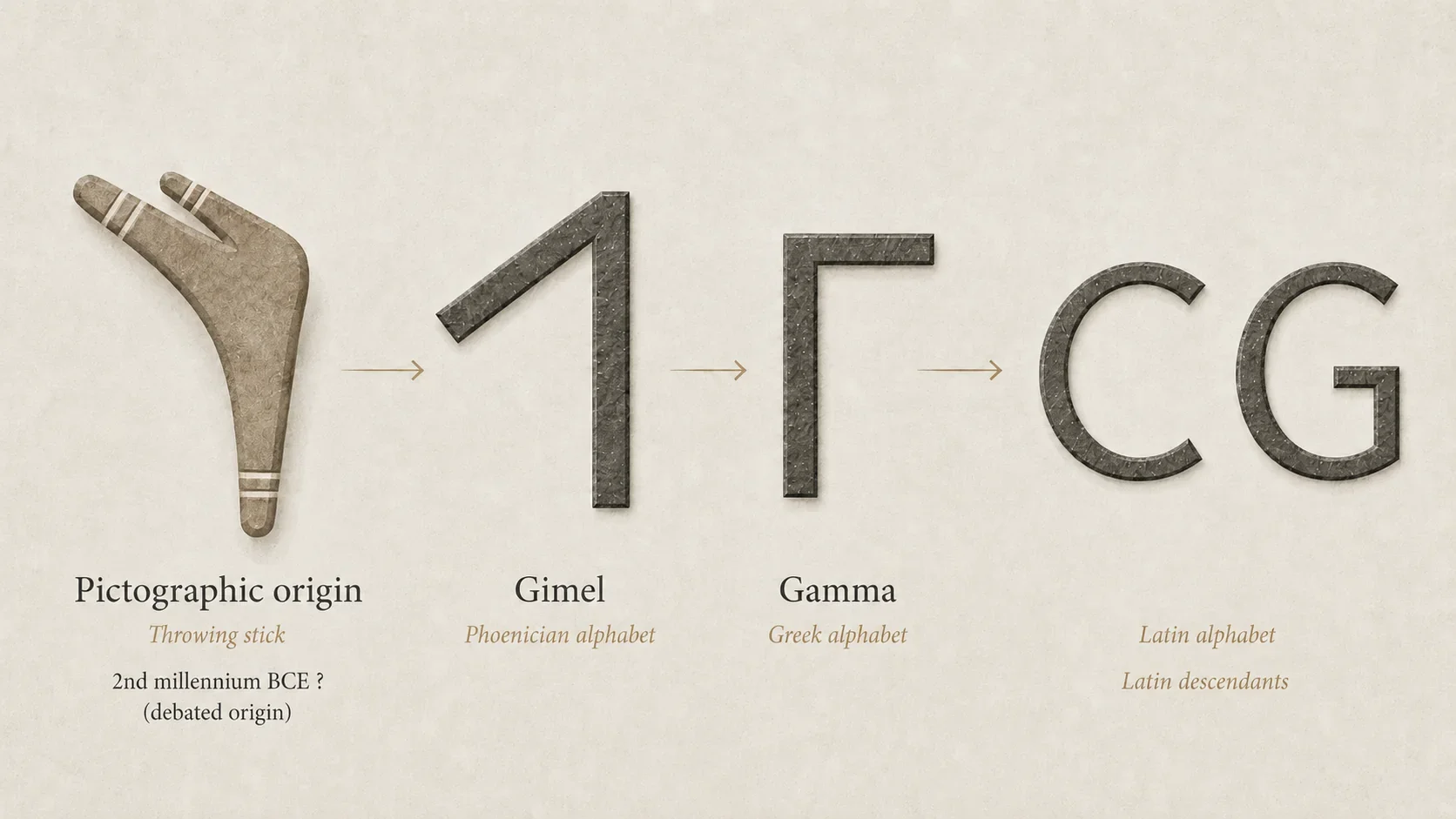
In the Semitic tradition, the name of the letter has been associated with the camel. Its pictographic origin, however, is not established with the same degree of certainty. Some reconstructions have proposed an earlier sign associated with a throwing stick. However, no prototype for Gimel has been identified with certainty in the Proto-Sinaitic corpus.
An origin that remains debated
Early alphabets relied largely on the acrophonic principle: an object was represented, its name supplied the initial sound, and the image gradually developed into a written sign.
For Gimel, however, the relationship between the original image and the Phoenician letter 𐤂 is less certain.
The association with the camel comes from the name transmitted through later Semitic traditions. Other reconstructions have proposed a sign associated with a throwing stick. No pictographic prototype of Gimel, however, has been identified with certainty in the Proto-Sinaitic corpus.
It would therefore be misleading to state that 𐤂 simply represents a camel.
What can be established more securely is its function:
Gimel is the third letter of the Phoenician alphabet and represents the sound /g/.
Here, uncertainty is part of the story.
From Gimel to Gamma
When the Phoenician alphabet was adapted by the Greeks, Gimel became:
Gamma — Γ
Gamma retained its position as the third letter and, in Ancient Greek, its consonantal value /g/.
But the next stage of its history is more complex than that of Aleph or Beth.
A western form of Gamma passed into the Italic and then Etruscan alphabets. From this graphic tradition emerged the Latin C.
The Romans initially used C in a system in which the sounds /k/ and /g/ were not yet distinguished graphically in the way we know today.
In the 3rd century BCE, a modification of C led to the creation of G, allowing the two sounds to be distinguished in writing.
Gimel therefore ultimately contributed to the history of two Latin letters:
C and G.
𐤂 → Γ → C → G
This time, transmission did not follow a simple straight line.
A single ancient letter became part of the history of two characters in our alphabet.
Gimel and Byblos
With Gimel, the connection to Byblos appears directly in the ancient name of the city.
In Phoenician inscriptions, Byblos is written GBL.
Its first consonant is G — Gimel.
The inscription of Ahiram includes the formula MLK GBL, “King of Byblos”. The same group GBL also appears in other royal inscriptions from the city.
Gimel is therefore not only a letter attested in the writing system used at Byblos.
Phonetically, it also opens the ancient name of the city:
GBL — conventionally vocalized as Gebal.
Three signs at the beginning of a name transmitted across millennia.Gimel tells a less straightforward story than Aleph or Beth.
Its pictographic origin remains debated, but its transmission is particularly visible: Gimel became Gamma and later contributed to the history of the letters C and G.
In Byblos, this third letter also stands at the very beginning of the city’s ancient name: GBL.