
Daleth — 𐤃
Fourth letter of the Phoenician alphabet.
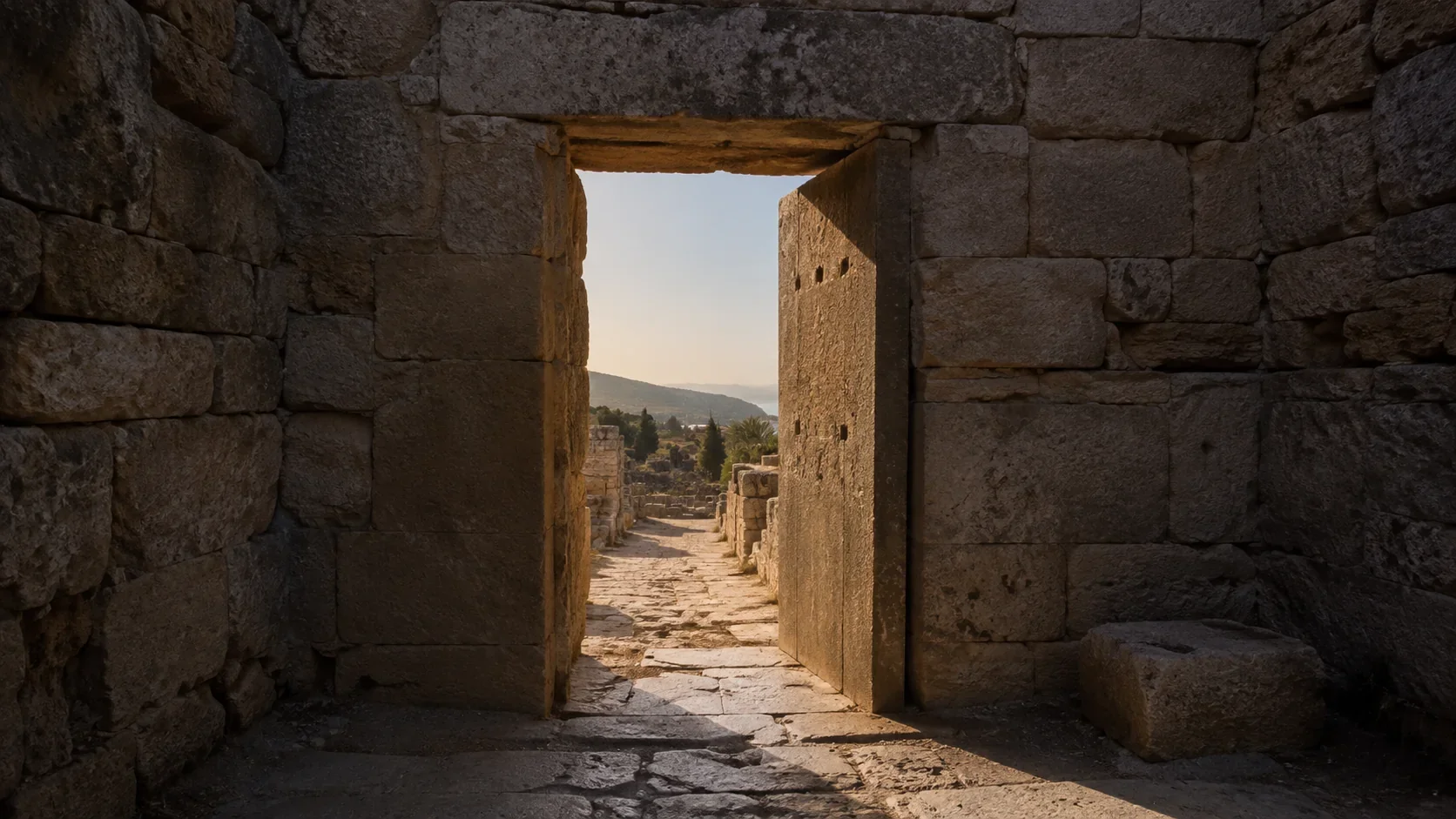
Before D, there was Daleth.
𐤃 is the fourth of the twenty-two letters of the Phoenician alphabet. Its phonetic value corresponds to the sound /d/.
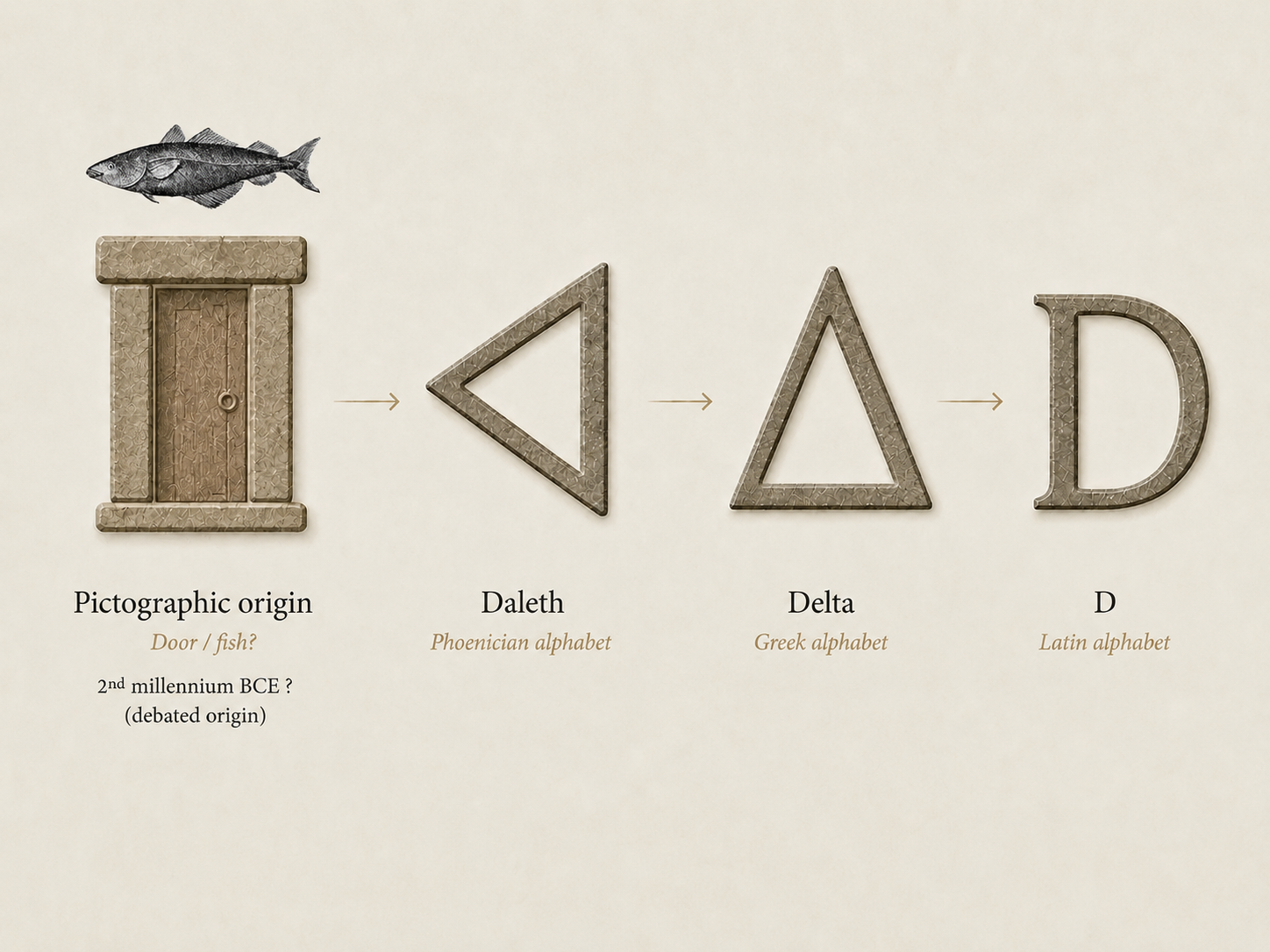
Its name, Daleth, is associated with the Semitic word for “door”. But the pictographic origin of the sign is more uncertain: in the earliest alphabetic writings, two representations have notably been proposed for the sound /d/ — a door and a fish.
But as with Gimel, the name transmitted through the alphabetic tradition should be distinguished from the exact identification of the pictogram from which the letter may have originated.
An origin that remains debated
Early alphabets used signs, many of which developed from images of familiar objects.
For the consonant /d/, however, the story is less straightforward than it may first appear.
In Proto-Sinaitic inscriptions, several scholars identify a sign representing a fish, associated with the Semitic word dag. Another sign has been interpreted as a door, dalt. Since both words begin with the sound /d/, either could have represented that sound according to the acrophonic principle.
Scholars do not entirely agree on the identification of these early signs. It is possible that different forms coexisted before one alphabetic tradition gradually became dominant.
The name transmitted through later Semitic alphabets is Daleth, associated with the door.
It would therefore be too categorical to present the Phoenician letter 𐤃 simply as the graphic simplification of either a door or a fish.
The name Daleth refers to the door, but the exact pictographic ancestor of the sign remains debated.
What is much more securely established is its function within the Phoenician alphabet:
𐤃 represents the sound /d/.
From Daleth to Delta
When the Greeks adapted the Phoenician alphabet, Daleth became:
Delta — Δ
The name changed, but the letter retained its fourth position in the alphabet and, in Ancient Greek, a consonantal value corresponding to /d/.
Its shape, however, changed considerably.
The Phoenician sign developed in Greek writing into the characteristic triangular form of Delta — Δ.
The letter was subsequently transmitted through alphabets used in ancient Italy before entering the Latin alphabet.
It eventually became:
D
𐤃 → Δ → D
Daleth therefore offers a particularly clear example of alphabetic transmission: different graphic forms, connected across languages and centuries by the history of writing.
Daleth and Byblos
In Byblos, Daleth can be found in one of the city’s important royal inscriptions: the inscription of Yehimilk.
Dated on palaeographic grounds to approximately 950–920 BCE, this seven-line Phoenician inscription was discovered at Byblos.
The text includes the group:
𐤒𐤃𐤔𐤌 — QDŠM
Daleth — 𐤃 — is its second letter.
In this context, the term refers to the sacred or holy gods of Byblos. The inscription invokes several divine powers associated with the city.
Daleth is therefore more than an abstract stage in the distant history of our letter D.
It is a sign that was actually inscribed at Byblos nearly three thousand years ago.
Conclusion
With Daleth, a door opens onto a history whose earliest details are not entirely certain.Its name refers to the door. Its pictographic origin, among several early signs associated with the sound /d/, remains debated. Its later transmission, however, is much clearer:
Daleth became Delta, and eventually D.
And in Byblos, the letter can still be encountered in the inscriptions left by the city’s ancient rulers.