
Mem — 𐤌
Thirteenth letter of the Phoenician alphabet.

Before M, there was Mem.
Mem is the thirteenth of the twenty-two letters of the Phoenician alphabet.
In this consonantal writing system, it represents the sound /m/.
Its name is associated with water. Here, the relationship between the letter name and its proposed pictographic ancestor is relatively well documented: early alphabetic inscriptions from Sinai use a wavy sign interpreted as water, while Semitic languages preserve related words such as mayim in Hebrew and mym in Phoenician. The Metropolitan Museum presents the early M sign precisely as a representation of water that gradually became abstract.
As always, the exact intermediate graphic stages should be understood as palaeographic reconstructions.
From the Phoenician alphabet onward, however, the lineage becomes very clear:
Mem — 𐤌 → Mu — Μ → M
The sound value also remains essentially stable throughout this transmission: /m/.
From water to a letter
The earliest alphabets did not begin with fully abstract shapes.
Several signs appear to have developed from simple images — an ox head, a house, a hand — whose names were then used acrophonically to represent sounds.
For Mem, the image is water.
The Metropolitan Museum shows an early M sign from Serabit el-Khadim as a wavy line. The sign does not represent the sound itself, but water, designated by a Semitic word beginning with /m/. Over time, the image becomes simplified and increasingly abstract until it functions as an alphabetic character.
Comparative charts of Proto-Sinaitic likewise trace the sequence:
water → Mem → Mu
and explicitly associate Mem with the meaning “water”.
We can therefore be more confident here than with Teth or Zayin:
the connection between Mem and water is one of the better-supported pictographic reconstructions in the early alphabetic tradition.
This does not mean that every intermediate form can be reconstructed with certainty.
What is established in the Phoenician alphabet is much simpler: Mem — 𐤌 occupies the thirteenth position and represents the consonant /m/.
Water had become a letter.
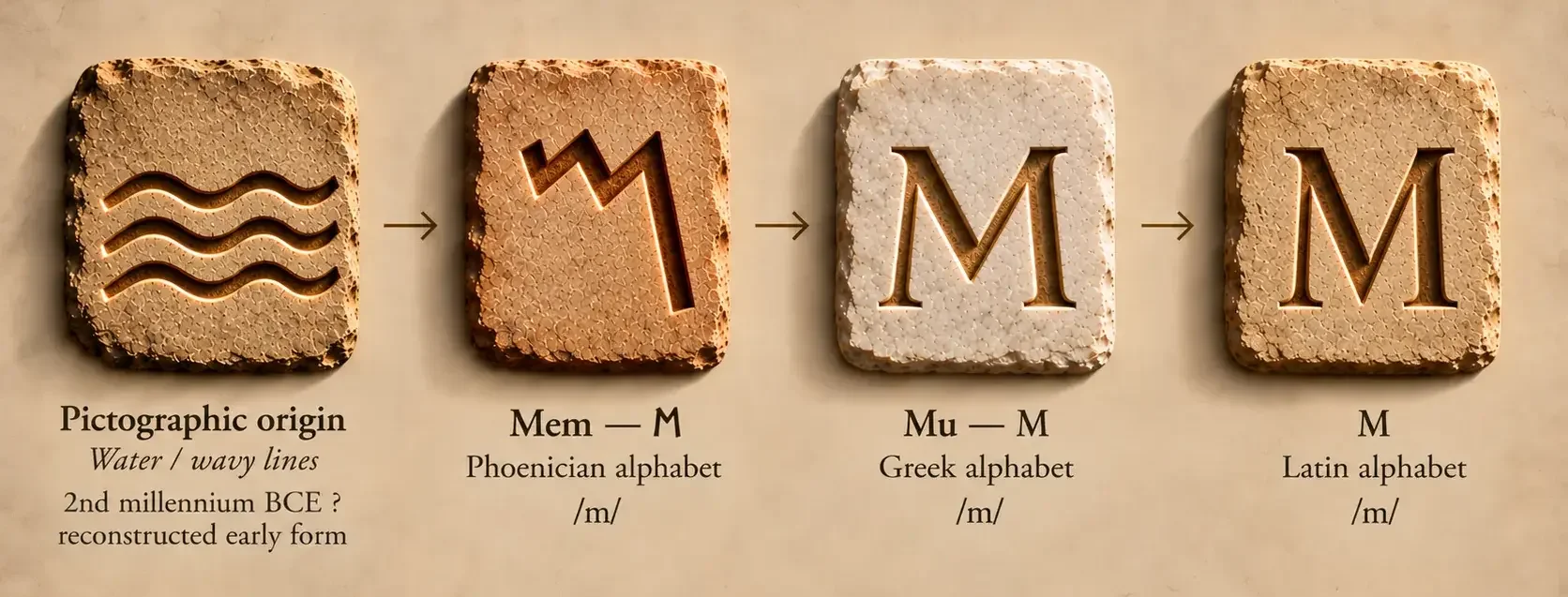
From Mem to Mu, then M
When the Greeks adapted the Phoenician alphabet to their own language, they also adopted Mem.
The letter became:
Mu — Μ
It retained the sound /m/.
Its shape evolved, but for a long time it preserved an angular structure inherited from Semitic writing. Early Greek alphabets used several variants before the form Μ became standard.
Mem is the thirteenth letter of the Phoenician alphabet.
Mu is now the twelfth letter of the Greek alphabet, following the disappearance of some archaic letters from the Greek sequence.
The sign was then transmitted through Italic alphabets, including Etruscan, and into Latin.
It became:
M
The lineage is particularly clear:
Mem — 𐤌 → Mu — Μ → M
And unlike He, Heth or Yod, the function barely changes.
The sound remains:
/m/ → /m/ → /m/.
It is one of the most stable transmissions in the history of the alphabet.
Mem and Byblos
In Byblos, Mem appears repeatedly in the royal inscriptions of the early first millennium BCE.
The Yehimilk inscription, generally dated to around 950–920 BCE, offers a particularly useful example. The text invokes several deities and asks them to prolong the king’s days and years over the city.
Among the divine names appears:
BʿLŠMM — Baalshamem
The sequence ends with two Mems.
The inscription also repeatedly uses the royal title:
MLK — king
whose first consonant is likewise Mem — 𐤌.
Mem therefore appears in both the vocabulary of royal power and the names of deities invoked by the rulers of Byblos.
This repeated presence reminds us of something essential: the letters followed in this series are not merely a sequence of graphic forms.
In Byblos, Mem belongs to a language actually carved into stone, used to name kings, gods, buildings and the city itself.
Conclusion
With Mem, the path from image to letter is particularly easy to follow.
At the beginning stands a sign associated with water, represented by wavy lines.
In the Phoenician alphabet, that image becomes Mem — 𐤌, the thirteenth letter of the sequence and the consonant /m/.
The Greeks adopt it as Mu — Μ.
The letter then passes through the Italic alphabets and into Latin:
Mem — 𐤌 → Mu — Μ → M
The shape changes.
The sound remains remarkably stable.
More than three millennia after the earliest alphabetic writing, our M still preserves both the phonetic value and part of the graphic heritage of Mem.
Sources and references
The Metropolitan Museum of Art — Alphabet Origins: From Kipling to Sinai
A particularly useful reference for Mem. The Met reproduces an early M sign from Serabit el-Khadim and explicitly explains its wavy form as water, associated with the Phoenician mym. The article also follows the broader process by which pictorial signs became increasingly abstract alphabetic letters.
Anshuman Pandey — Revisiting the Encoding of Proto-Sinaitic in Unicode
A comparative study of Proto-Sinaitic signs and their descendants. The table for MEM explicitly gives the meaning “water” and connects the early sign with Phoenician Mem and Greek Mu.
Encyclopaedia Judaica — “Mem”
A palaeographic overview tracing the development of the sign from Proto-Sinaitic forms associated with water to Phoenician Mem and later Semitic scripts.
DEAPS — Digital Editions of Aramaic and Phoenician Sources, KAI 004
Academic edition of the Yehimilk inscription, palaeographically dated to approximately 950–920 BCE. The text includes MLK, “king,” and BʿLŠMM, Baalshamem, in which Mem appears several times.