
He — 𐤄
Cinquième lettre de l’alphabet phénicien.

Avant le E, il y avait He.
𐤄 est la cinquième des vingt-deux lettres de l’alphabet phénicien. Dans cette écriture consonantique, elle note le son /h/.
Son histoire est particulièrement intéressante : lorsque les Grecs adaptent l’alphabet phénicien, ils conservent la lettre mais en transforment la fonction.
Une consonne deviendra une voyelle.
Une origine difficile à reconstituer
Comme plusieurs lettres de l’alphabet phénicien, He possède une histoire qui remonte aux premières écritures alphabétiques du Proche-Orient.
Mais son origine pictographique n’est pas aussi clairement établie que celle d’Aleph ou de Beth.
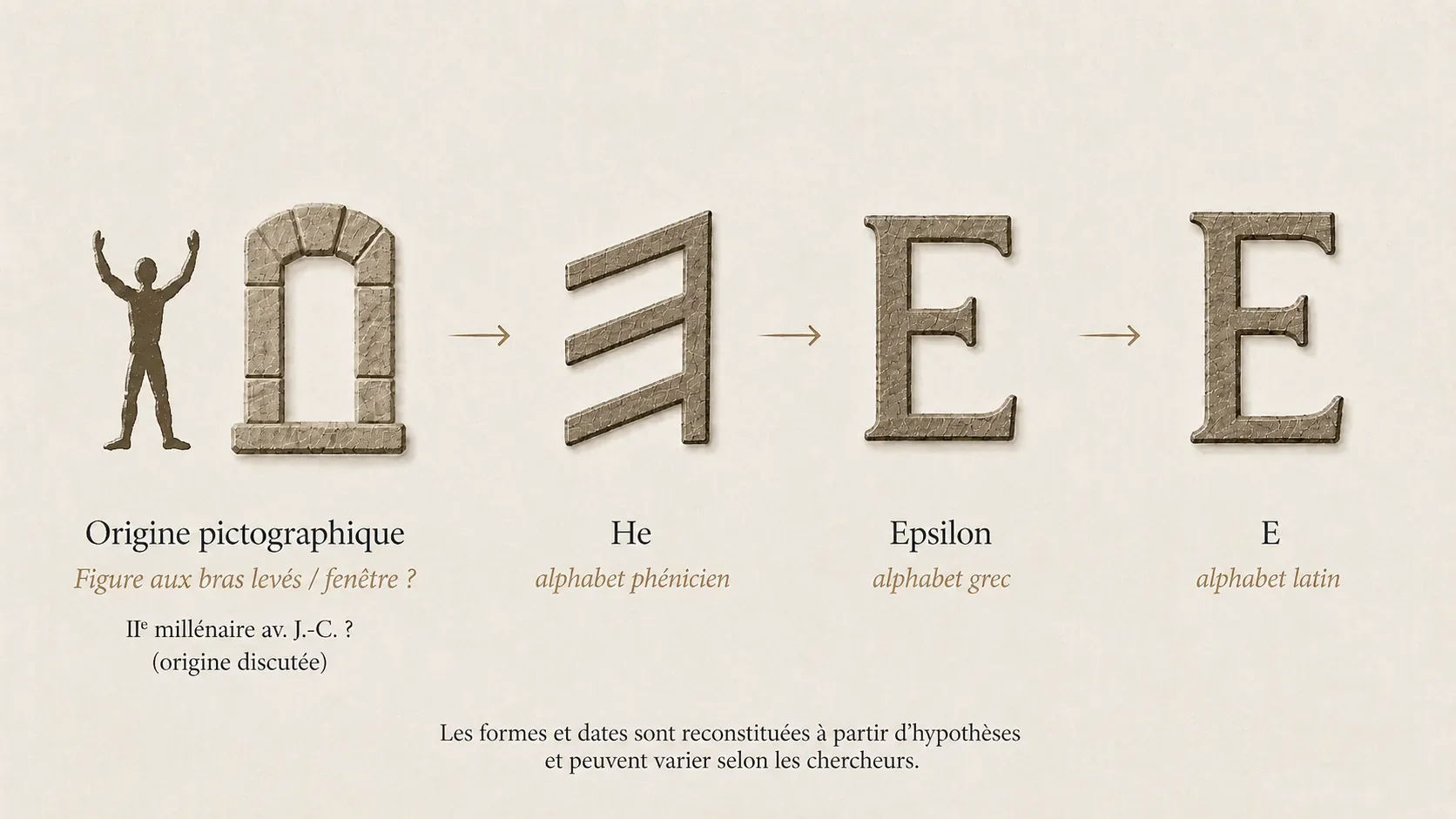
Dans les inscriptions proto-sinaïtiques, l’un des signes proposés comme ancêtre de He représente une figure humaine debout ou en marche, les bras levés. Selon une reconstruction notamment défendue par l’égyptologue Orly Goldwasser, ce geste pourrait avoir été associé à un appel ou une exclamation, permettant de noter le son /h/ selon le principe acrophonique.
L’association de He avec une fenêtre ou une ouverture, fréquemment reprise dans les tableaux modernes de l’alphabet, appartient à une autre tradition d’interprétation. Elle ne doit pas être confondue avec une origine pictographique établie.
Il serait donc trop affirmatif de présenter He comme la simple transformation graphique d’une fenêtre.
L’origine exacte du signe reste discutée, mais la figure humaine aux bras levés constitue l’une des principales reconstructions proposées pour son ancêtre proto-sinaïtique.
Ce que l’on connaît avec beaucoup plus de certitude est la fonction de la lettre dans l’alphabet phénicien :
𐤄 représente la consonne /h/.
Avec He, l’image qui a pu se trouver à l’origine du signe s’est progressivement effacée derrière une forme alphabétique abstraite.
De He à Epsilon
Lorsque les Grecs adaptent l’alphabet phénicien, ils reprennent également sa cinquième lettre.
Mais ils lui attribuent une nouvelle fonction.
Le He phénicien, qui notait une consonne /h/, est utilisé pour représenter un son vocalique /e/ et devient la lettre grecque :
Epsilon — Ε
Cette transformation fait partie d’une innovation fondamentale de l’alphabet grec : plusieurs signes consonantiques phéniciens sont réutilisés pour noter explicitement des voyelles.
La lettre est ensuite transmise aux Étrusques, puis aux Romains.
Elle devient le E latin que nous utilisons encore aujourd’hui.
𐤄 → Ε → E
La forme évolue relativement peu.
Sa fonction, elle, change profondément :
d’une consonne à une voyelle.
He et Byblos
À Byblos, He permet d’observer une autre dimension de l’histoire de l’alphabet : la transformation graphique des lettres au fil du temps.
En 1923, Pierre Montet découvre dans la région des temples de Byblos un petit autel portant une inscription phénicienne tardive.
Lors de sa première étude, René Dussaud remarque précisément la forme particulière de He. Les deux traits principaux de la lettre y apparaissent dissociés, une évolution qu’il compare à celle observée sur des monnaies antiques d’Arados.
La datation exacte de l’inscription a depuis été discutée, mais son intérêt paléographique demeure : la forme de He montre que les lettres phéniciennes ne sont pas restées graphiquement immuables.Des inscriptions archaïques aux témoignages beaucoup plus tardifs, sa forme continue d’évoluer.
À Byblos, He témoigne ainsi de la longue durée d’une écriture qui, elle aussi, s’est transformée avec le temps.
Conclusion
Avec He, l’histoire de l’alphabet ne se résume plus à l’évolution d’une forme.
La cinquième lettre phénicienne 𐤄, qui représentait une consonne /h/, devient en grec Epsilon — Ε, une voyelle, avant de donner naissance au E latin.
𐤄 → Ε → E
Un même signe, transmis d’une langue à l’autre, mais utilisé autrement.