
Aleph — 𐤀
First letter of the Phoenician alphabet

Before A, there was Aleph.
𐤀 is the first of the twenty-two letters of the Phoenician alphabet. Its name, Aleph, refers to the ox.
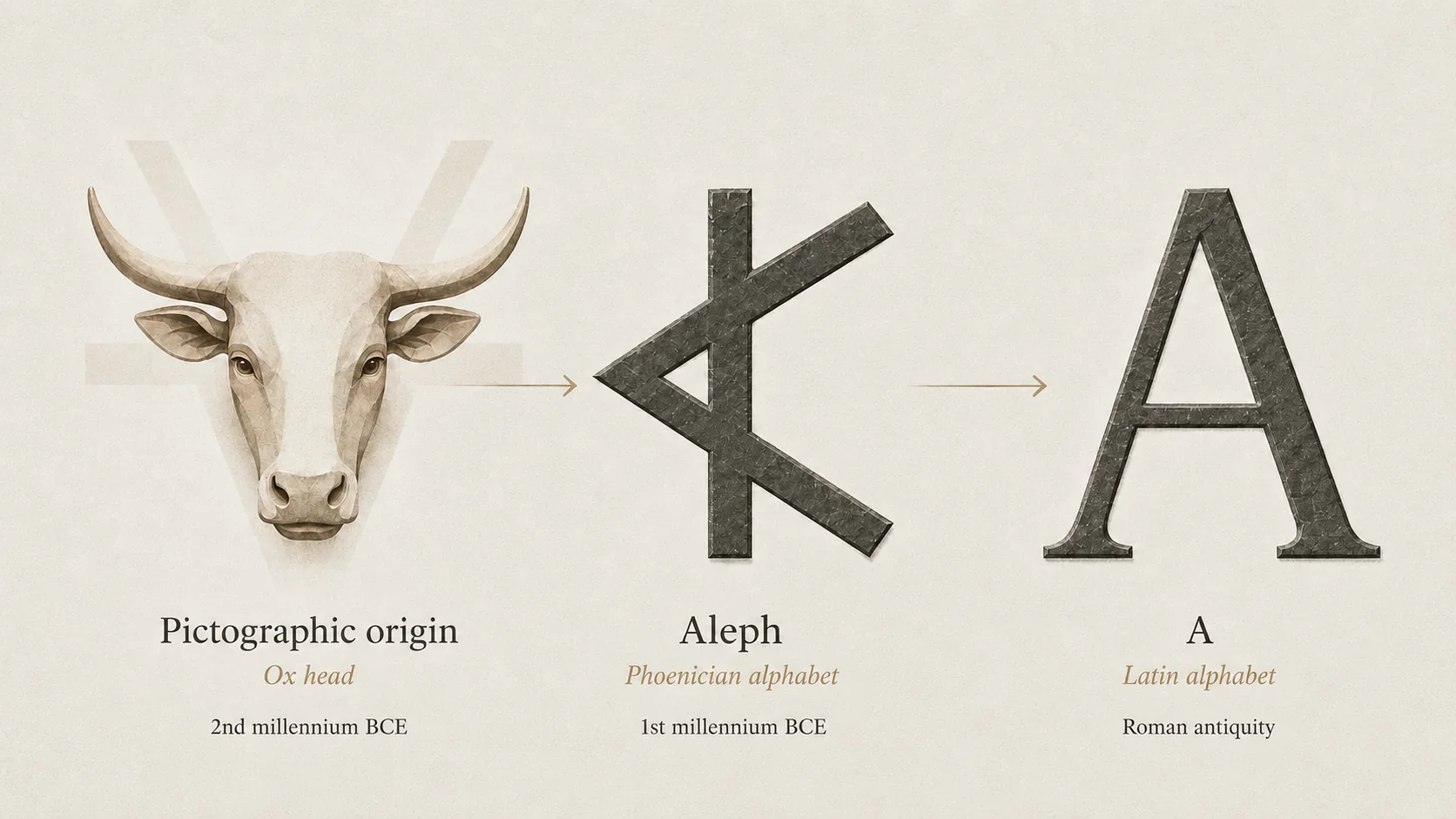
Behind this abstract sign lies a much older image: the head of a bovine.
From ox to letter
Aleph belongs to a history of writing that begins before the Phoenician alphabet.
Early alphabetic systems of the ancient Near East used signs derived from recognizable forms. In the case of Aleph, the image was that of an ox head.
Over time, this pictorial form became increasingly abstract. In the Phoenician alphabet, it took the form 𐤀.
An image became a written sign.
From Aleph to Alpha
From the first millennium BCE onward, Phoenician writing is attested far beyond the Levant, across different shores of the Mediterranean.
When the Greeks adapted the Phoenician alphabet to their own language, they also retained the order and names of several letters.
Aleph became Alpha — Α.
Its function changed, however. Phoenician Aleph represented a consonant, generally reconstructed as the glottal stop /ʔ/, while the Greeks adapted the sign to represent the vowel /a/.
The Greek alphabet was later transmitted and transformed through the Etruscan and Roman worlds.
From this long history came the Latin A.
𐤀 → Α → A
Three forms belonging to different languages and periods, yet part of the same history of transmission and transformation.
Aleph and Byblos
Byblos holds a particular place in this history.
Several Phoenician inscriptions discovered in the city are major witnesses to the use of this writing system. Among them are inscriptions associated with the kings Ahiram, Yehimilk, Elibaal and Shaphatbaal. UNESCO specifically cites these inscriptions when describing Byblos as directly and materially associated with the history of the diffusion of the Phoenician alphabet.
The inscription on the sarcophagus of King Ahiram was discovered in the royal necropolis of Byblos. The sarcophagus is now preserved at the National Museum of Beirut. The existing English Visit Byblos documentation also identifies the Ahiram inscription as one of the key objects for understanding the city's place in the history of alphabetic writing.
In Byblos, Aleph therefore belongs to a history that extends far beyond a single sign.
It is part of the transmission of a writing system whose transformations continued across the Mediterranean.
From the ox head to the Latin A, Aleph tells not only the story of a changing form, but of a sign transmitted and transformed from one language to another.