The Origin of the Phoenician Alphabet
Before becoming a widespread tool, writing was a complex system.
For centuries, it relied on large sets of signs, difficult to master, reserved for trained scribes.
Then, on the eastern shores of the Mediterranean, another principle emerged.
In Byblos and across the Phoenician cities, a simpler system took shape.
An alphabet reduced to a limited number of signs, capable of recording the essential sounds of a language.
A discreet transformation — but a decisive one.
Before the Alphabet: Writing Without Simplification
The earliest writing systems, in Mesopotamia and Egypt, were complex by nature.
Hundreds of signs were required to record words, ideas, or sounds.
Learning these systems demanded time and training, restricting writing to a limited group of specialists.
These systems made writing possible — but not widely accessible.
A Radical Reduction
The Phoenician alphabet introduced a different logic.
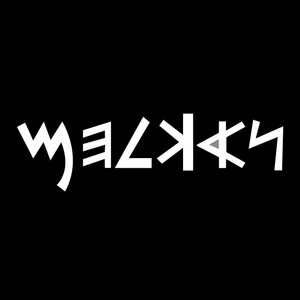
Instead of multiplying signs, it reduced them. It draws on forms taken from the real world—animals, objects, or parts of the human body—gradually stylized and abstracted into signs.

Generatec with AI for illustration purpose
Twenty-two letters were enough to record the consonants of a language.
Vowels were not written.
This choice fundamentally transformed writing:
• fewer signs to learn
• faster execution
• wider dissemination
Writing was no longer confined to administrative or religious contexts.
It became a reproducible system.
A System Linked to Exchange
The emergence of this alphabet was not isolated.
Phoenician cities — including Byblos — were active centers of exchange.
Trade with Egypt, Mesopotamia, and across the Mediterranean created new needs:
• recording goods
• identifying names
• transmitting information efficiently
In this context, a simple and functional writing system became an advantage.
Early Inscriptions
Evidence of this alphabet appears in several inscriptions.
Among the most significant is the inscription on the sarcophagus of Ahiram, discovered in Byblos.
Dated to the late second or early first millennium BCE, it presents an already structured form of the Phoenician alphabet.
It shows that this system was not experimental.
It was established — and used in official contexts.
A Progressive Diffusion
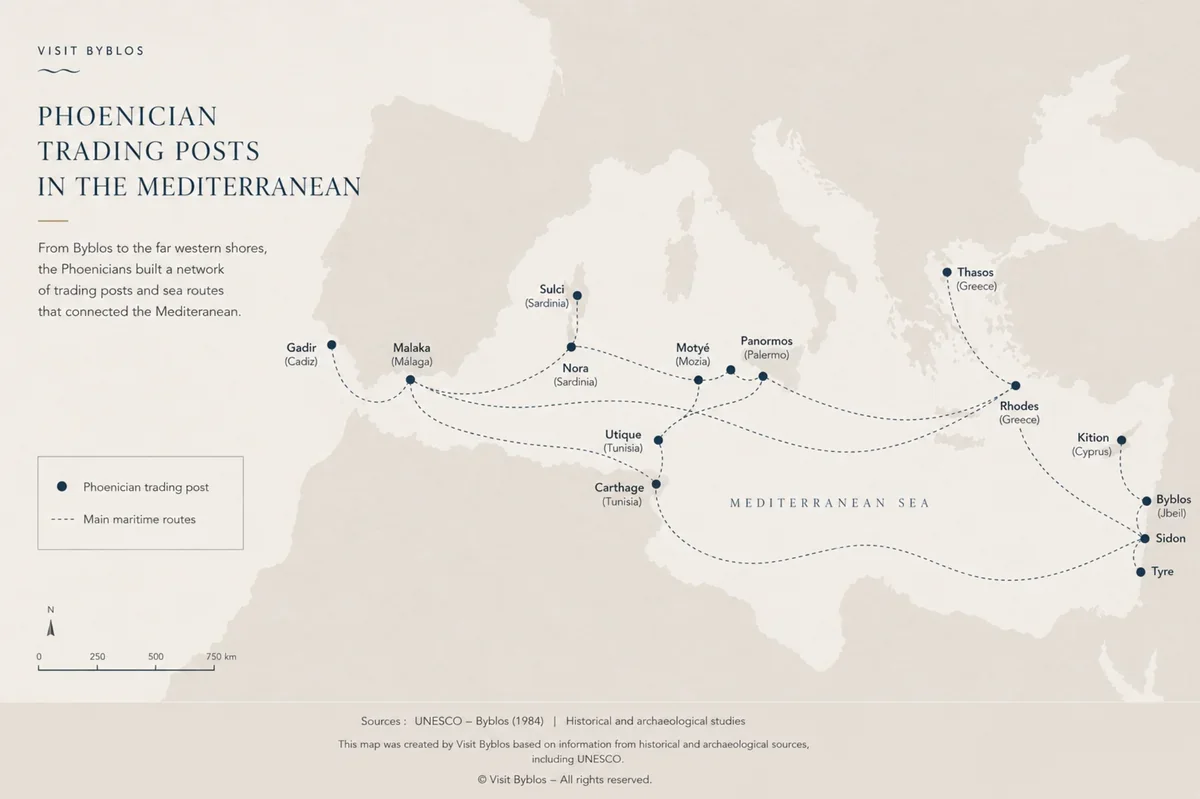
The Phoenician alphabet did not remain confined to its place of origin.
Through maritime trade networks, it circulated.
Phoenician merchants and navigators carried this writing system across the Mediterranean.
It was then adapted by other cultures.
The Greeks introduced vowels.
The Romans inherited and transformed this system further.
The alphabet we use today is an indirect continuation of these transformations.
A Structure That Endures
The Phoenician alphabet is no longer used as such.
But its structure remains. Try to write your name in phoenician using our interactive tool.
The principle of a limited number of signs associated with sounds is still at the core of modern writing systems.
What can be observed in Byblos is therefore not an isolated relic.
It is a foundational step in the history of how language is recorded and transmitted.
Byblos as a Point of Reference
While the Phoenician alphabet developed across a broader region, Byblos remains one of its key points of reference.
Archaeological discoveries made on the site — particularly during the twentieth century — have brought to light several major inscriptions.
The city appears not as the sole origin, but as a place where writing was anchored, used, and transmitted.
A place where the system became part of everyday economic, political, and cultural life.
The Phoenician alphabet does not represent a simple technical evolution.
It transforms not only the act of writing, but the way language is transmitted.
By reducing the number of signs, it makes writing more accessible.
By circulating across the Mediterranean, it extends beyond its place of origin.
What can be observed here, in Byblos, is not merely an origin.
It is a turning point.
This article is also available in French.
→ Lire la version française
Add Visit Byblos to your preferred sources to discover more content about Byblos on Google.